

In today’s fast-paced industrial and electrical world, safe and reliable power distribution has become the backbone of every system. Electrical panels in industrial factories, commercial buildings, and even homes have one component that silently ensures safety: the MCCB. If you’re wondering, what is the full form of MCCB, the answer is Molded Case Circuit Breaker.
This powerful device protects circuits from overloads and short circuits, keeping your electrical system safe. In this Guide, we’ll share the MCCB Full Form In Electrical, its function, types, advantages, and tips for choosing the right one in an easy and understandable way.
Table of Contents
MCCB Full Form (What is MCCB in Electrical?)
The full form of an MCCB is Molded Case Circuit Breaker. It is a type of circuit breaker in which all the main components are securely housed in a molded insulated shell. The molded case is a rigid, insulated box that protects all the electrical parts of the MCCB.
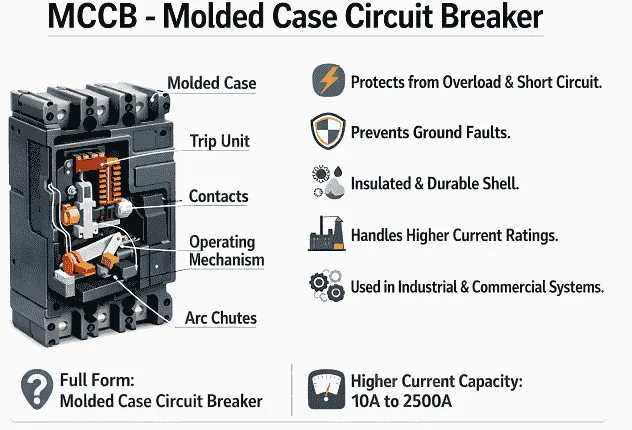
It not only protects the circuit from short circuits and overloads, but also protects the equipment from dust, moisture, and external influences. MCCBs can handle higher currents than smaller MCBs (Miniature Circuit Breakers) , so they are widely used in industrial machinery, large equipment, and commercial power distribution.
Read More In Hind: RCCB क्या है?
What does an MCCB do?
An MCCB (Molded Case Circuit Breaker) protects electrical circuits and connected equipment from a variety of hazardous conditions. Its main functions are:
1. Overload Protection
An overload occurs when current flows beyond a set limit for a long time. The thermal trip unit (bimetallic strip) in the MCCB detects this. The strip heats up and trips the circuit, preventing damage to equipment and wiring and potentially dangerous situations like fire.
2. Short Circuit Protection
A short circuit causes a sudden and very high surge in current. The MCCB’s magnetic tripping mechanism activates instantly, breaking the circuit within milliseconds. This stops the excessive current and prevents fire, equipment failure, or serious damage.
3. Ground Fault Protection
Some MCCB models also feature ground fault detection, which reacts immediately to any leakage or fault current to ground (earthing), preventing electric shock and equipment damage.
4. Manual Switching
An MCCB can also be used as a switch. It can be manually turned on or off, which is useful for maintenance or de-energizing a circuit.
5. Adjustable Tripping
Many MCCBs have the ability to set the trip current according to the load, allowing it to be customized for different equipment and industrial loads.
Read More In Hindi: RCCB कैसे काम करता है?
Main Components Of An MCCB
An MCCB (Molded Case Circuit Breaker) is made up of several components that protect the circuit from overload, short circuit, and arcing. Its main components are:
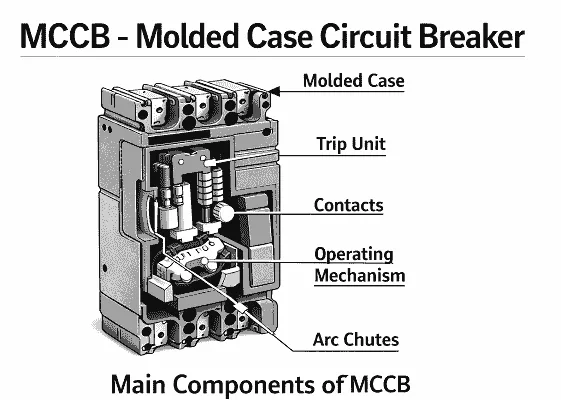
- Molded Case/Frame: Strong and insulated box that protects all internal components from dust, moisture and external damage.
- Contacts: The metallic conductors that pass current through a circuit. MCCBs have fixed and moving contacts and are made of arc-resistant material.
- Trip Unit: The “brain” of the MCCB that trips the circuit. There are three types of tripping
- Thermal: Bimetallic strip heats up and bends when subjected to prolonged overload.
- Magnetic: On short circuit the solenoid activates and trips instantly.
- Electronic: Provides advanced and programmable security.
- Operating Mechanism / Handle: Allows manual switching on, off, or tripping. Has a trip-free mechanism.
- Arc Chutes: Prevents fire or damage by extinguishing sparks generated during tripping.
- Terminal Connectors: Connect the MCCB to the external circuit. The top terminals are connected to the load, and the bottom terminals are connected to the supply.
- Trip Button: Used to manually trip the breaker or to check the tripping system.
Read More In Hindi: MPCB (Motor Protection Circuit Breaker) क्या है?
How do MCCBs work?
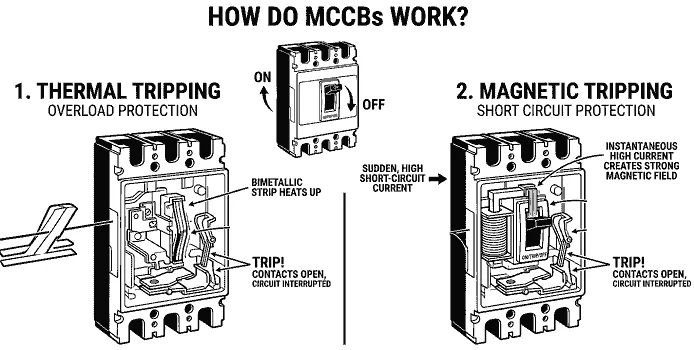
An MCCB (Molded Case Circuit Breaker) acts as both a circuit switch and a safety device. It is normally “on” and allows current to flow. An MCCB has two main tripping techniques, making it safe and reliable:
Thermal tripping
During prolonged overload current, the bimetallic strip in the MCCB heats up and bends. This bending activates the tripping mechanism and immediately cuts off the circuit, protecting equipment and wiring.
Magnetic Tripping
In case of a sudden and rapid current, such as a short circuit, the MCCB’s solenoid coil generates a strong magnetic field. This immediately activates the tripping mechanism and shuts off the circuit within milliseconds.
Arc-quenching chambers (Arc Chutes) immediately extinguish the sparks generated during tripping, preventing the risk of fire or other damage.
Additional information: Modern MCCBs may also include an electronic trip unit, which provides highly precise and programmable protection. This makes tripping more customizable and secure.
Read More In Hindi: MPCB कैसे काम करता है?
How many types of MCCB are there?
MCCBs (Molded Case Circuit Breakers) come in various types to provide the right protection for different circuits and applications. They can be classified primarily based on poles, tripping characteristics, and application.
1. Based on Poles
- Pole (1P): For single-phase loads, such as residential air conditioners.
- Pole (2P): 230V single phase system, for small industrial machines.
- Pole (3P) : For motors and heavy industrial machinery in 3-phase systems.
- Pole (4P/TPN) : For sensitive equipment including 3-phase and neutral, such as data centers or hospitals.
2. Based on tripping unit (Trip Unit Type)
- Thermal-magnetic MCCB: The most common type. The thermal unit handles prolonged overload conditions, while the magnetic unit trips immediately on a short circuit.
- Electronic MCCB: Programmable and adjustable, for precise protection and remote monitoring.
3. Tripping Characteristics (Trip Curve Types)
- Type B : For light loads with low inrush current. Can withstand currents 3–5 times the rated current.
- Type C : For general industrial and commercial loads. Withstands currents 5–10 times the rated current.
- Type D : For motors with high inrush current or large industrial loads. Withstands 10–20 times the rated current.
- Type K : For high inertia inductive loads. Withstands 10–12 times the rated current.
- Type Z : The most sensitive MCCB. It trips when the current is 2–3 times the rated current. It is used in semiconductor- based and expensive devices.
4. Application Based
- Industrial MCCB: For heavy loads and high short-circuit ratings (100kA+).
- Commercial MCCB: For small, light loads and use in offices/apartments.
5. Based on trip settings
- Fixed Trip: The setting cannot be changed.
- Adjustable Trip: The current limit can be set as required, thereby customizing the protection according to the load.
Read More In Hindi: MCB कैसे काम करता है?
MCCB Testing Procedure
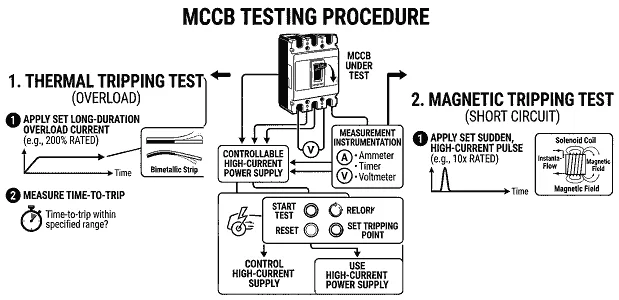
Regular testing of an MCCB (Molded Case Circuit Breaker) ensures that it operates accurately and reliably under conditions such as overload, short circuit, and ground fault. MCCB testing primarily involves the following steps:
- Visual and physical inspection: Disconnect the MCCB from the panel and examine the body, handle, terminals, and connections. Inspect for any fractures, corrosion, loose connections, or the presence of dust/debris.
- Manual Operation and Mechanical Check: Operate the handle several times in the ON, OFF, and TRIP positions. Also, check the functionality of the push-to-trip button and ensure there is no mechanical failure.
- Insulation Resistance Test: Disconnect the MCCB from the main circuit. Measure the phase-to-phase and phase-to-ground insulation using a megger. Ensure the value is no less than the highest MΩ specified by the manufacturer.
- Contact Resistance Test: Measure the resistance of the closed contacts using a micro-ohmmeter. This should be low enough to avoid problems such as voltage drop or heat.
- Tripping Test: Thermal Tripping (Overload Protection): Pass a current of about 3–4 times the rated current and observe that the breaker trips within the specified time.
- Magnetic Tripping (Short Circuit Protection): Check that the breaker trips immediately by giving short pulses of high current.
- Arc Extinguishment and Safety Check: Trip the breaker and ensure that the arc chutes are safely extinguishing the spark.
Read More In Hindi: Air Circuit Breaker क्या है?
Advantages of MCCB
The MCCB (Molded Case Circuit Breaker) is one of the most reliable and effective electrical safety devices. Its numerous advantages make it essential in industrial and commercial setups.
- High safety and reliability – Instant protection against overload (thermal) and short-circuit (magnetic), reducing the risk of fire and equipment damage.
- High breaking capacity – safe operation in large industrial motors , pumps and heavily loaded circuits.
- Adjustable Trip Settings – Allows you to adjust the current rating and trip time as needed.
- Resettable – Can be reset after tripping, more convenient than a fuse.
- Safe and Durable – Robust molded case and arc suppression technology, low maintenance and long life.
- Compact design – Secures large loads in a small size, saving panel space.
- Remote and Multipurpose Use – Remote switching facility, use in both AC and DC applications.
Difference between MCCB and MCB: How to Choose the Right Circuit Breaker?
- The MCCB (Molded Case Circuit Breaker) is suitable for large and heavily loaded circuits. Its molded case is strong and durable, and it features adjustable tripping settings. The MCCB can handle high currents and severe short circuits, making it ideal for industrial and commercial applications.
- An MCB (Miniature Circuit Breaker) is designed for small and lightweight circuits. It is commonly used in homes, apartments, or small offices. MCBs come with fixed tripping settings and provide adequate protection for light loads.
MCB (Miniature Circuit Breaker) and MCCB (Moulded Case Circuit Breaker) both are devices to protect the circuit from overload and short-circuit, but there are major differences in their usage, capacity and structure.
Current Rating
- MCB: Usually less than 100A (eg 6A, 10A, 32A, 63A)
- MCCB: 100A to 2500A or more, for heavy industrial loads
Uses / Applications
- MCB: Suitable for domestic, small office and low load circuits
- MCCB: For high load circuits in industrial machinery, factories and large panels
Trip Setting
- MCB: Fixed, non-replaceable
- MCCB: Adjustable, can be set as per requirement
Interrupting Capacity
- MCB: Mild short circuit protection
- MCCB: High breaking capacity, can handle heavy short circuits also
Cost
- MCB: Low
- MCCB: Expensive (High), but provides greater protection and load capacity
The table below explains the MCCB vs MCB comparison in a simple manner, so that you can choose the right circuit breaker as per your need.
| Feature | MCCB | MCB |
|---|---|---|
| Full Form | Moulded Case Circuit Breaker | Miniature Circuit Breaker |
| live long | Durable for heavy loads and repeated tripping | For small loads, limited life |
| Current Rating | 100 A – 2500 A+ | 1 A – 125 A |
| accuracy | Tripping setting adjustable | Fixed tripping setting |
| Usage Area | Industrial and commercial heavy loads | Home and small offices |
| price | High, but reliable | Low, sufficient for small loads |
Read More In Hindi: Vacuum Circuit Breaker क्या है?
MCCB Price in India: By Size, Type and Brand
The price of an MCCB (Molded Case Circuit Breaker) depends on several factors, such as its current rating, number of poles, tripping technology, and brand. Prices can vary significantly for industrial and commercial applications.
Typical MCCB prices in India:
- 100 A, 3-pole, thermal-magnetic MCCB: 6,500 – 12,000 Rupees This basic model is suitable for small and medium industrial loads or commercial setups.
- 250A, 3-pole, thermal-magnetic MCCB: 15,000 – 25,000 Rupees Ideal for use in heavy industrial machines or factories.
- 4-Pole, 2500 A, Electronic MCCB: 32,000 – 64,000 Rupees For large three-phase systems and high-complex industrial setups such as data centers or factory halls.
Key factors affecting the price:
- Pole Number: 1-pole or 2-pole models are cheaper, while 3-pole and 4-pole are more expensive.
- Type of Trip Unit: Thermal-magnetic MCCBs are cheaper, while electronic/programmable units are more expensive.
- Brand and Quality: Branded MCCBs like Schneider, L&T, Siemens, ABB etc. come with high reliability and long life, hence they cost a little more.
- Current Rating: The higher the current, the higher the price.
Read more : What is a Ammeter?
How to Choose an MCCB: A Guide to the Right Current, Voltage, and Safety
Choosing an MCCB isn’t just about choosing the right size, but also about choosing the one that best suits your circuit and protection needs. It’s important to consider the correct current, voltage, and breaking capacity.
- Current Rating: The current rating of the MCCB should be slightly above the maximum load of your circuit. For example, for a motor with a 40A rating, choose an MCCB with a rating of approximately 50A–55A (allowing up to 125% of full-load current in some applications).
- Voltage Rating: Ensure the MCCB is rated for the system voltage. A 230V rating is ideal for single-phase circuits and a 415V rating for three-phase systems.
- Short-Circuit Capacity: The breaking capacity of an MCCB must be greater than the maximum possible fault current of the circuit. For example, if the maximum fault current is 20kA, the Icu/Ics of the MCCB must be at least 20kA.
- Trip Unit Type: MCCBs have two types of trip units. Fixed trip units are a suitable and cost-effective option for systems with stable loads, where the trip settings cannot be changed. Adjustable trip units are designed for industrial or dynamic environments with varying load profiles, allowing for fine-tuning of thermal and magnetic trip settings.
- Environment & Protection: When choosing an MCCB for dusty, humid, or outdoor environments, choose a model with an IP rating of IP54 or higher. This ensures reliable protection over a long period of time.
Frequently Asked Questions (FAQs)
Question 1. What is the full form of MCCB?
MCCB stands for Molded Case Circuit Breaker. It is an electrical safety device that protects circuits against overloads, short circuits, and ground faults. MCCBs are designed for use with large currents and in industrial or commercial systems.
Question 2. Up to how many amperes does an MCCB operate?
MCCBs have a wide range of current ratings. They can typically handle currents ranging from 10 A to 2500 A. MCCBs rated at 10–100 A are available for small industrial or commercial circuits, while MCCBs rated at 1000 A to 2500 A are used for larger industrial machinery and factory power systems.
Question 3. Can MCCB be used as a switch?
Yes, an MCCB can also be used as a switch. An MCCB is essentially a circuit breaker, but it has a manual operating handle that allows you to turn it on or off. This means you can also use it as a switch to manually turn a circuit on or off.
However, keep in mind that the primary function of an MCCB is safety—protecting the circuit from overloads and short circuits. The option to operate like a switch is simply an added convenience.
Question 4. What is the tripping mechanism of MCCB?
An MCCB consists of a thermal and magnetic circuit protection unit. A thermal trip opens the contacts gradually through a bimetallic strip in response to an overload current, while a magnetic trip immediately trips the MCCB in response to a sudden short circuit. This protects the circuit from overloads and short circuits.
Question 5. What are the components inside an MCCB?
An MCCB consists of a molded case, contacts, a trip unit, an operating mechanism, terminal connectors, a handle/trip-free mechanism, and a trip button. These components together enable the MCCB to pass current, provide overload and short-circuit protection, and manually or automatically turn a circuit on/off.
Conclusion: MCCB Full Form and its Importance
Now you understand that MCCB stands for Molded Case Circuit Breaker. It’s not just a safety device, it serves as the backbone of electrical safety in industrial and commercial settings. It protects systems from hazardous conditions like overloads, short circuits, and ground faults, ensuring reliability.
Selecting the right MCCB—whether it’s 1-pole or 4-pole, thermal-magnetic or adjustable trip—should be based on your system’s current rating, load type, and environment. Using high-quality MCCBs can ensure your industrial power distribution system is safe and reliable over the long term.
