

In electrical systems, safety is not just a necessity, but a top priority. When a fault or leakage current occurs in any circuit, if it is not safely discharged, it can cause significant damage or even an accident. To prevent this danger, an essential process is used: earthing.
There are many types of earthing, but one of the most reliable and widely used method is Plate Earthing. In this article, we will understand Plate Earthing in a simple way – what is Plate Earthing and how it is done, how to understand Plate Earthing diagram, what are its advantages, what should be the resistance value of Plate Earthing, and how is it different from other methods.
Table of Contents
What is earthing?
Electrical systems can sometimes experience situations where current deviates from its intended path and begins flowing to external components—especially when a device’s insulation weakens or an internal fault occurs. Such a situation can be extremely dangerous, as it directly impacts user safety.
The safe solution to this problem is earthing . Earthing is a technique in which the external metal parts of electrical equipment and systems are connected directly to the ground using a low-resistance conductor.
Whenever an unwanted or fault current occurs in the system, it is immediately discharged into the earth through this designated path rather than reaching a person. This not only reduces the risk of electric shock but also protects wiring systems and equipment from damage.
What is Plate Earthing?
Plate earthing is a traditional but highly reliable earthing method used to protect electrical systems. In this method, a metal plate—usually copper or galvanized iron (GI)—is installed at an appropriate depth in the ground and connected to the electrical system.
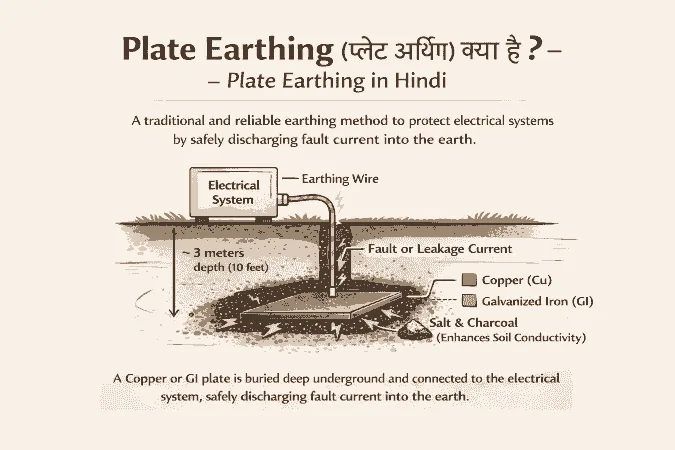
When a fault or leakage current occurs in the system, this plate provides a safe path for that current . The current is easily dissipated into the earth through this conductive plate, protecting both people and equipment from harm.
Plate earthing is characterized by its stability and reliability. This method can effectively adapt to different soil types and varying electrical loads, making it widely adopted in applications ranging from homes to large industrial installations.
How does plate earthing work?
The working principle of Plate Earthing is basically based on the fact that the fault current should always be given the path of least resistance , so that it can flow safely into the ground.
When an electrical system experiences a fault, leakage current, or insulation failure, the excess current automatically moves toward the path with the lowest resistance. Plate earthing works on this principle, providing a defined and safe path for the current, leading directly to the earthing plate.
This metal plate (copper or GI) embedded in the ground dissipates the current through itself into the surrounding soil. Since soil is a highly conductive medium, it slowly absorbs this current and neutralizes it.
The biggest advantage of this entire process is that the current is discharged directly into the ground rather than coming into contact with a person or equipment. As a result,
- The risk of electric shock is largely eliminated.
- And electrical equipment is also saved from getting damaged.
Overall, Plate Earthing acts as a reliable safety mechanism, keeping the electrical system stable and safe by safely diverting unwanted current to the ground.
Read more : What is Earthing?
Plate Earthing Diagram
This Plate Earthing Diagram explains the entire working of the system in a simple way.
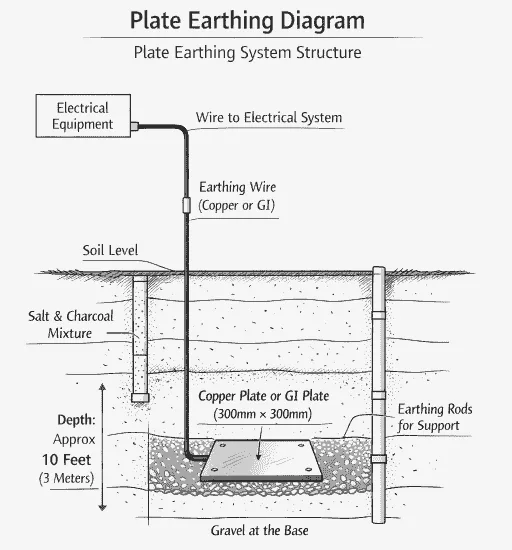
This plate earthing diagram shows the electrical equipment at the top, from which an earthing wire extends into the ground. This wire serves to safely conduct fault or leakage current to the earth.
A copper or GI plate is placed underground at a depth of approximately 3 meters (10 feet). This plate is the main part of the earthing system, spreading the current throughout the soil. Salt and charcoal are placed around the plate, increasing the soil’s conductivity and reducing resistance.
This Plate Earthing Diagram also shows a pipe on the side, which is used to maintain moisture so that the earthing remains effective. A layer of gravel is provided at the bottom, which helps with drainage and stability.
Whenever a fault occurs in the system, the current travels through the wire to the plate and from there safely dissipates into the ground, preventing shock and equipment damage.
Read more : What is Pipe Earthing and how is it done?
Complete Material List for Plate Earthing with Specifications
To ensure a proper and effective plate earthing system, certain essential materials are used. Each component has its own specific function, making the entire earthing system reliable and long-lasting.
1. Metal Plate (Earth Plate)
This is the main part of the entire system, serving as the electrode. Two types of plates are commonly used:
- Copper Plate: 600mm × 600mm × 3.15mm
- GI Plate (Galvanized Iron): 600mm × 600mm × 6mm
These plates are installed deep in the ground, so that the fault current can easily discharge into the earth.
2. Charcoal
A layer of charcoal is placed around the plate. Its primary purpose is to increase the soil’s conductivity, allowing for better current flow.
3. Salt
Salt is used to retain moisture. This reduces the resistivity of the soil and increases the efficiency of the earthing system.
4. Earthing Wire / Strip
This wire or strip connects the plate to the electrical system (such as a distribution board or panel). The fault current is carried directly to the plate.
5. GI Pipe (water pipe)
This is used to maintain moisture in the pipe plate. Water is added periodically to keep the surrounding soil dry and maintain conductivity.
6. Nuts & Bolts
These are used to firmly connect the earthing wire or strip to the plate, so that the connection does not loosen.
7. Cast Iron Cover / Chamber
It is installed over the earthing pit to keep the system safe and provide easy access for maintenance.
Read more : What is a voltmeter and how does it work?
How to Do Plate Earthing? Step-by-Step Installation Guide with Diagram
Installing plate earthing correctly is extremely important, as its efficiency directly depends on the quality of the installation. If each step is followed correctly, low resistance and improved safety can be easily achieved. The entire process is explained below in simple and clear language.
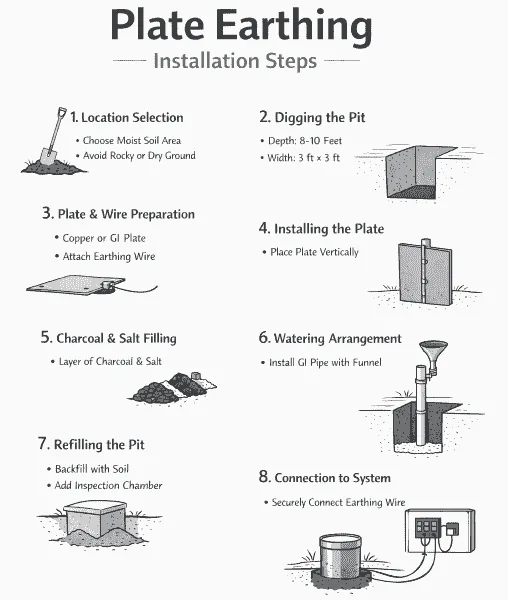
Step 1: Location Selection
First, choose a location with natural soil moisture. Extremely dry or rocky ground should be avoided, as this can increase earthing resistance. If there is water nearby, it’s even better.
Step 2: Digging the Pit
A pit approximately 2.5 to 3 meters (8–10 feet) deep is dug at the selected site. Its width is usually 1 meter by 1 meter for ease of installation.
Step 3: Plate & Connection Preparation
Now take a copper or GI plate (approximately 600mm × 600mm) and securely connect an earthing wire or strip to it using a nut and bolt. This connection should be strong and corrosion-free.
Step 4: Installing the Plate
The prepared plate is carefully installed inside the pit in a vertical position, so that its maximum surface area is in contact with the soil.
Step 5: Charcoal & Salt Filling
Layers of charcoal and salt are placed alternately around the plate. These layers increase the soil’s conductivity and help retain moisture, improving earthing performance.
Step 6: Watering Arrangement
A GI pipe, approximately 19mm in diameter, is installed near the plate, and a funnel can be placed on top. This is used to periodically pour water into the soil to maintain moisture.
Step 7: Refilling the Pit
The pit is then carefully filled with soil. A small inspection chamber is created at the top, making future inspections and maintenance easier.
Step 8: Connection to Electrical System
Finally, the earthing wire is connected to the electrical panel or related equipment. It is important to ensure that all connections are strong, secure, and free of corrosion.
Read more : What is Potential Transformer?
Important Precautions in Plate Earthing for Safe Installation
The effectiveness of plate earthing depends not only on the material or design, but also on proper installation practices. A few simple precautions can ensure long-term performance and safety of the entire system.
- Choosing the right pit depth: The depth of the pit should always be determined based on the soil moisture. Earthing is more effective where the moisture is good.
- Standard plate size: Copper or GI plates must be sized according to established standards. Only the correct size plate can effectively discharge current.
- Use Same Material Connection: The earthing plate, earthing lead (wire/strip), and nut/bolt must be made of the same metal. Using different metals can increase corrosion and weaken the connection.
- Strong and tight connections: All joints and connections must be perfectly tight. Loose connections can increase resistance, reducing earthing efficiency.
By following these precautions, the Plate Earthing system remains reliable and safe for a long time.
Read more : All Types of Home and Industrial Wiring
Why is a copper plate used in earthing?
Copper plates are used in earthing systems primarily because of their high electrical conductivity. Copper is a very good conductor, allowing fault current or leakage current to flow smoothly into the ground. This significantly increases the safety of the electrical system and reduces the risk of accidents.
Another important characteristic of copper is its very low corrosion resistance. Moisture and various chemical elements are present in the ground, but copper is not easily affected by these. This allows copper plates to remain undamaged over time, maintaining the reliability of the earthing system.
Additionally, copper has a very low resistance, making the earthing system more efficient. This low resistance means that fault current has an easier path to the ground, further improving equipment safety.
Copper plates’ long life is another major factor. Once installed, they can function efficiently for many years without requiring significant maintenance. This is why copper plates are preferred in high-quality earthing systems.
Read more : How does RCCB work?
Where is Plate Earthing Used? Applications and Uses Explained
Plate earthing is used where low resistance, high reliability, and improved safety are required. This method is particularly suitable for environments where electrical loads are high or fault current levels may be high.
- Residential Buildings: Plate earthing is used in homes to protect electrical appliances. It reduces the risk of electric shock by safely directing leakage current to the ground and also protects the wiring system.
- Industries and Factories: Where heavy machinery and high-power equipment are used, a robust earthing system is essential. Plate earthing provides reliable performance in such areas and protects equipment from faults.
- Substations and Power Plants: In high- voltage systems such as substations and power plants, fault current levels can be very high. Plate earthing is used to quickly and safely discharge this current into the ground.
- Large Commercial Buildings and Hospitals: Safety is paramount in places like commercial complexes, malls, and hospitals. Plate earthing provides continuous and stable protection, protecting even sensitive equipment.
- Areas with low conductivity soil: Where the ground is dry, sandy or low conductivity, plate earthing is preferred as it gives better and stable results than other methods.
Read more : How does MCB work?
Plate Earthing vs Pipe Earthing: Key Differences and Which is Better?
Plate earthing and pipe earthing are two of the most common and widely used methods in electrical systems. Both have the same primary purpose of safely diverting fault current to the ground, but their working methods, installation, and performance differ.
The question often arises as to which of these two methods is more efficient, cost-effective, and reliable over the long term. The right choice depends on your needs, soil conditions, and application.
In the table below, we will explain the main differences between Plate Earthing and Pipe Earthing in simple language, so that you can choose the right earthing method for yourself.
| Feature | Plate Earthing | Pipe Earthing |
|---|---|---|
| Materials used | Copper or GI plate is used | GI Pipe is used |
| Installation | A bit difficult and time consuming | Easy and fast |
| Depth | More depth required | Possible even at shallow depths |
| Resistance | Very low | Moderate |
| Maintenance | A little more attention is required | Easy |
| Life Span | More (especially copper plate) | Medium |
| Efficiency | more reliable | General |
| Uses (Application) | Industry, large systems | Home, small systems |
Read more : What is a fuse?
Why is Plate Earthing Better Than Pipe Earthing? Key Reasons Explained
Plate earthing is considered superior to pipe earthing in many situations, especially when reliable and long-term earthing is required. This is primarily due to its superior performance and stability.
Plate earthing involves placing a large metal plate (copper or GI) underground, providing a greater surface area. This greater surface area improves contact with the earth, lowering resistance and allowing fault current to flow more easily into the ground. In contrast, pipe earthing has a relatively smaller contact area.
Additionally, plate earthing works well in dry or less conductive soil. While pipe earthing can be less efficient, plate earthing is more stable. This is why it is preferred in challenging soil conditions.
Another advantage of plate earthing is its consistency and reliability. It provides long-term stable performance and is more suitable for large electrical systems such as industries, substations, and high-load installations.
Although plate earthing has a higher installation cost than pipe earthing and is more difficult to install, plate earthing is a better option where safety and performance are paramount.
Read more : What is a diode?
Difference between Plate Earthing and Mat Earthing
Plate Earthing and Mat Earthing both are important earthing methods used for electrical safety but their usage, structure and functionality are different from each other.
- Plate earthing involves burying a copper or GI plate deep in the ground. This system is used in small and medium electrical installations where earthing is required over a limited area.
- Mat earthing (also called Earth Grid) involves laying a number of conductors (GI strip / copper strip) in the ground as a grid. It is used for large areas and high voltage systems.
The main difference between Plate Earthing and Mat Earthing is explained in the table below.
| Feature | Plate Earthing | Mat Earthing (Mat Earthing / Earth Grid) |
|---|---|---|
| Structure | Use of a metal plate | A grid is made of wire/strip |
| Area Coverage | Limited area | Covers a large area |
| Safety Level | General | quite high |
| Resistance Control | Limited | more effective |
| Uses (Application) | Home, small industries | Substation, power plant |
Read more : What is Fan Capacitor?
How to Check Plate Earthing by 4-Point Method (Wenner Method)?
The 4-Point Method doesn’t directly measure the resistance of the plate earthing, but rather the soil resistivity. This value determines how effective your plate earthing will be, so it’s considered an indirect but very reliable method.
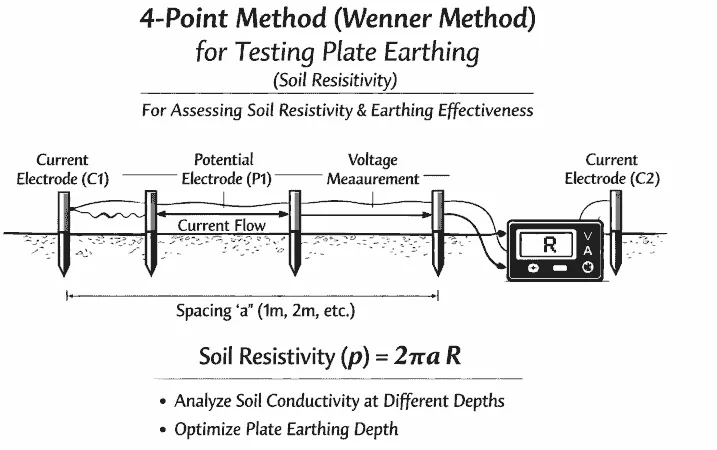
In this, four electrodes are placed in the ground at equal distances (a) in a straight line. Current is passed through the outer electrodes and voltage is measured through the inner electrodes. The soil resistivity is then calculated using the formula ρ = 2πaR .
If the resistivity is high, it means the earthing resistance will also be high. In this case, increasing the depth, maintaining moisture (salt and charcoal), or installing additional earthing becomes necessary. You can also analyze different soil depths by varying the spacing and determine the ideal plate depth (approximately 3m+).
This method is especially used in substations and industrial projects where accurate earthing design is essential.
Read more : What is Coulomb’s Law?
Advantages Of Plate Earthing
Plate earthing is considered a reliable and long-lasting earthing method. Some of its key advantages are:
- Low Resistance Path: It provides a very low resistance path for the fault current, allowing the current to drain quickly and safely to ground.
- High Current Handling Capacity: Plate earthing can easily handle heavy fault current, hence it is suitable for high load systems.
- Long Life: Especially with the use of copper plate, this system works for a long time without any major problems.
- Stable & Reliable Performance: Once installed correctly, it provides consistently stable performance, thereby maintaining the overall safety of the system.
- Suitable for Industrial Applications: This method proves to be especially useful in industries, substations and large electrical setups.
Frequently Asked Questions (FAQs)
Question 1. What is Plate Earthing?
Plate earthing is a method of safely directing electrical fault current to the earth by burying a copper or GI plate in the ground. This protects equipment and reduces the risk of electric shock.
Question 2. What should be the depth of Plate Earthing?
A depth of about 3 meters (10 feet) is considered ideal for plate earthing, to maintain soil moisture and minimize resistance. For optimal performance, the plate should always be installed in moist soil.
Question 3. Which plate is used in Plate Earthing?
Plate earthing typically uses copper or GI (Galvanized Iron) plates. Copper plates offer better conductivity and lower resistance, while GI plates are more cost-effective and are more commonly used in general applications.
Question 4. Why do we add salt and charcoal in plate earthing?
Salt and charcoal are added in plate earthing because they increase the conductivity of the soil and maintain moisture, due to which the earthing resistance is reduced and the fault current is easily discharged into the ground.
Question 5. How long does Plate Earthing last?
With proper maintenance, plate earthing can typically last 10–20 years or more. Copper plate has a longer lifespan than GI plate because it is less prone to corrosion.
Conclusion
Simply put, plate earthing isn’t just an electrical method, but a solid foundation for safety. Especially in areas where loads are high and even a small fault can cause significant damage, this system serves as a reliable safety shield.
While installation can be a bit more expensive and labor-intensive, its performance more than makes up for it in the long run. Properly installed and regularly maintained, plate earthing provides years of trouble-free, smooth, and safe operation.
If you need strong, durable and low-resistance earthing, Plate Earthing is a reliable and long-term solution.
