

A voltmeter is an important electrical measuring instrument used to measure the voltage (potential difference) between two points in a circuit. This helps ensure that a circuit or device is operating at the correct voltage. Voltmeters are widely used in laboratories, electronics, and industrial fields.
In this article, we will understand in detail what a voltmeter is and how it works, as well as its types and uses.
Table of Contents
What is a Voltmeter?
Definition of Voltmeter: A voltmeter is an electrical instrument used to measure the voltage (potential difference) between two points in a circuit.
Voltage is usually measured in:
- Volts (V)
- Millivolts (mV)
- Kilovolts (kV)
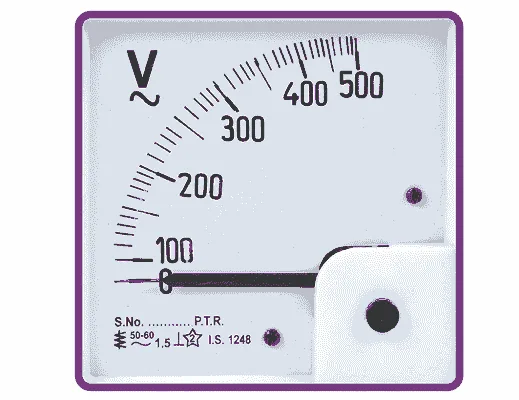
A voltmeter is an important tool used in electrical and electronics work. It helps us check if a circuit, battery, or device is working properly and getting the correct voltage. In simple words, it tells us how much electrical pressure is present between two points in a circuit.
Voltmeter Diagram
This voltmeter diagram shows the main parts of a voltmeter. The red (+) and black (-) probes are connected in parallel to the circuit. The moving coil, or galvanometer, moves the needle according to the voltage.

A series resistor (Rs) increases the voltmeter’s resistance and draws less current from the circuit. Analog voltmeters have a needle and scale to show the reading, while digital ones display the voltage directly on a screen. This design makes voltage measurement easy and safe.
Symbol of a Voltmeter
A voltmeter is represented in circuit diagrams by a simple and easy-to-recognize symbol. It is shown as a circle with the letter “V” written inside it, along with two terminals on opposite sides of the circle. These terminals indicate where the voltmeter should be connected in the circuit.

Learn More: What is MCCB
Working Principle of Voltmeter
The working of a voltmeter is mainly based on Ohm’s Law, which states:
𝑉 = 𝐼 × 𝑅
- Where,
- V = voltage
- I = Current
- R = Resistance
How Does a Voltmeter Work? (Step-by-Step Explanation)
- High Internal Resistance: A voltmeter has very high internal resistance, which allows only a small amount of current to pass through it. This ensures that the circuit works normally without any disturbance during measurement.
- Parallel Connection: It is always connected in parallel with the component or part of the circuit where voltage needs to be measured. This connection helps in getting correct and reliable readings.
- Voltage Divider: Inside the voltmeter, a voltage divider is used to reduce the input voltage to a safe level. This protects the instrument and allows it to measure different voltage levels.
- Measurement and Display: In an analog voltmeter, the current creates a magnetic effect that moves a needle to show the reading. In a digital voltmeter, the voltage is converted into numbers and displayed on the screen.
- Measurement Range: Voltmeters can measure different voltage ranges. Selecting the correct range before measurement is important for accuracy and safety.
Learn More: RCCB Full Form in Electrical
Why is a Voltmeter Connected in Parallel in a Circuit?
A voltmeter is always connected in parallel with a circuit or component. This is because it has very high internal resistance, which allows only a tiny amount of current to flow through it. As a result, it does not disturb the normal working of the circuit and gives accurate voltage readings.

Main Reasons
- Accurate Voltage Measurement: Voltage is the difference between two points. When connected in parallel, the voltmeter measures the actual voltage across that component correctly.
- No Effect on Circuit: Due to its high resistance, the voltmeter takes very little current from the circuit. This ensures that other components continue to work normally.
- Correct Readings: A parallel connection helps the voltmeter show the true voltage value with minimum error. If it is connected in series by mistake, it can block the current flow and give wrong readings.
Why Does a Voltmeter Have High Resistance?
A voltmeter is made with very high internal resistance because its main job is to measure the voltage (potential difference) between two points accurately.
Because of this high resistance, only a very small amount of current flows through the voltmeter. This ensures that the normal current in the circuit is not disturbed, and the circuit works as it should.
If the voltmeter had low resistance, it would draw more current from the circuit. This could change the behavior of the circuit and give wrong voltage readings. That is why a voltmeter’s resistance is kept as high as possible.
Since a voltmeter is always connected in parallel, high resistance also prevents the main current from being diverted into the meter. This helps in getting correct and reliable measurements.
In an ideal case, the resistance of a voltmeter is considered infinite, which means it does not draw any current at all.
Voltmeter Formula with Example
A voltmeter is made by connecting a high resistance (called a multiplier) in series with a galvanometer. This high resistance helps the voltmeter measure higher voltages safely.
Main Formula:
V = Im × Rse + Vm
- Where:
- V = voltage to be measured
- Im = Full Scale Deflection Current
- Rse = Series Resistance (Series Resistance / Multiplier)
- Vm = full scale voltage of the galvanometer
Simple Understanding: The total voltage is equal to the voltage drop across the series resistance plus the voltage across the galvanometer.
Formula for Series Resistance (Multiplier) in Voltmeter
To increase the voltage range of a voltmeter, a high resistance (called multiplier) is connected in series with the galvanometer. This resistance controls the current so that only the required amount flows through the meter.
Rse = (V / Im) – G
Where:
- Rse = Series resistance (multiplier)
- V = Maximum voltage to be measured
- Im = Full-scale deflection current (in ampere)
- G = Internal resistance of the galvanometer
Simple Idea: The series resistance is chosen so that the galvanometer does not get damaged, draws very little current, and gives accurate readings.
Example: Suppose you want to measure voltage up to 150 V using a voltmeter. The galvanometer inside the voltmeter has a full-scale current of 1 mA (0.001 A) and an internal resistance of 50 ohms.
Find the value of the series resistance (Rse) required.
- Given:
- V = 150 V, Im = 1 mA = 0.001 A, G = 50 Ω
- Formula: Rse = (V / Im) – G
- Rse = (150 / 0.001) – 50
- Rse = 150000 – 50
- Rse = 149950 Ω (≈ 150 kΩ)
- Final Answer: The required series resistance (multiplier) is 149950 Ω, or approximately 150 kΩ.
Range of Voltmeter
The range of a voltmeter means the minimum and maximum voltage it can measure. This range depends on the type of voltmeter and its application.
- DC Voltmeter: can measure voltages from about 10 mV to 1000 V
- AC Voltmeter: can measure voltages from about 1 V to 1000 V
To measure higher voltages, a high series resistance (called a multiplier) is added inside the voltmeter.
Least Count of an Analog Voltmeter
The least count of an analog voltmeter is the smallest voltage value it can measure. It depends on how many divisions are marked on the scale.
Formula: Least Count = Total Voltage Range ÷ Total Divisions
Example: If a voltmeter has a range of 0 to 20 V and the scale is divided into 200 equal parts, then:
Least Count = 20 ÷ 200 = 0.1 V
Simple Meaning: This means the voltmeter can measure a minimum voltage difference of 0.1 volt. A smaller least count indicates better accuracy of the instrument.
Learn More: Charging an Electric Car with Solar Panels
Types of Voltmeter and their uses
Voltmeters can be classified into different types based on their working method, accuracy, and application. Each type is used for specific purposes in electrical and electronic circuits.

Analog Voltmeter
An analog voltmeter uses a needle (pointer) and a scale to show voltage. The needle moves according to the voltage applied.
- Used in basic electrical measurements
- Simple design but less accurate than digital meters
- Common in older devices and training labs
Digital Voltmeter (DVM / DMM)
A digital voltmeter shows the voltage in numeric form on a screen (LCD/LED).
- Provides high accuracy and stable readings
- Easy to read and widely used in modern electronics
- Often used in multimeters for multiple measurements
PMMC Voltmeter (Permanent Magnet Moving Coil)
PMMC voltmeters are mainly used to measure DC voltage. They are very accurate and use less power. The needle moves according to the current produced by the voltage. Their range can be increased by adding a series resistance.
Moving Iron (MI) Voltmeter
MI voltmeters can measure both AC and DC voltage. The needle movement depends on the voltage across the coil. They are of two types: attraction type and repulsion type, and are strong and durable.
Rectifier Voltmeter
Rectifier voltmeters are used for AC voltage measurement. They first convert AC into DC and then measure it using a meter like PMMC or a galvanometer.
Amplified Voltmeter
Amplified voltmeters are used to measure very small voltages. They use an amplifier to increase weak signals, which makes them highly sensitive and very accurate.
Learn More: LT and HT Full Form in Electrical
Difference Between Analog & Digital Voltmeter
Both analog and digital voltmeters are used to measure voltage, but they work and display results in different ways.
Display Method
- An analog voltmeter shows voltage using a needle and scale, where you have to read the needle position.
- A digital voltmeter shows the voltage directly in numbers on a screen (LCD/LED).
Sensitivity
- Analog voltmeters have lower sensitivity, so they are not very accurate for small measurements.
- Digital voltmeters have high sensitivity and give more accurate results.
Speed
- Analog voltmeters are slower and cannot quickly follow rapid voltage changes.
- Digital voltmeters are fast and show readings instantly.
Ease of Reading
- In analog voltmeters, you need to interpret the needle position, which can sometimes be confusing.
- Digital voltmeters are easy to read because they display exact numbers.
Power Consumption
- Analog voltmeters use very little power and usually do not need a battery.
- Digital voltmeters require a battery or power supply to work.
Cost
- Analog voltmeters are generally cheap and affordable.
- Digital voltmeters are usually more expensive because they provide better accuracy and features.
Main Differences Between Analog and Digital Voltmeter
| Speciality | Analog Voltmeter | Digital Voltmeter |
|---|---|---|
| Display | Pointer and scale | Numerical display on LCD/LED |
| Accuracy | Less | High |
| readings | The need for interpretation | Direct numerical readings |
| Visibility | Easy to see fluctuations | Stable, quick readings |
| Cost | Cheap | Costly |
Attributes of an Ideal Voltmeter
An ideal voltmeter is a perfect device used to measure voltage between two points without disturbing the circuit.
Detailed Characteristics of an Ideal Voltmeter:
- Infinite Resistance: It has very high (infinite) internal resistance, so it does not allow current to flow through it.
- Zero Current Flow: Since resistance is infinite, no current passes through the voltmeter.
- No Loading Effect: It does not change or affect the original condition of the circuit while measuring voltage.
- High Accuracy: It gives exact and error-free readings every time.
- High Sensitivity: It can detect even very small changes in voltage.
- Temperature Independence: Its performance does not change with temperature.
- Fast Response: It shows readings instantly without delay.
- Good Resolution: It can clearly show even small differences in voltage.
How to Use a Voltmeter
To use a voltmeter correctly, you must connect it properly and choose the right settings. This helps you measure voltage safely and accurately.
First, set the voltmeter according to the type of circuit. If you are measuring an AC circuit, select ACV (V~) mode. If you are measuring a DC circuit, select DCV (V−) mode.
Next, choose a voltage range that is higher than the expected voltage. This prevents damage to the voltmeter and ensures safe measurement.
How to measure voltage using a voltmeter?
Step 1: Hold the probes properly. Do not touch the metal tips with your hands. If the wire insulation is damaged, use insulated gloves or replace the leads.
Step 2: Place the black (negative) probe at one point in the circuit. A voltmeter is always connected in parallel.
Step 3: Touch the red (positive) probe to another point in the circuit. Now the voltmeter will start showing the voltage.
Step 4: If the voltmeter shows overload or a very high reading, quickly increase the voltage range to protect the device.
Step 5: If a digital voltmeter shows 0V or no reading, or an analog voltmeter needle does not move, check and correct the settings.
Step 6: A digital voltmeter shows the value directly on the screen. An analog voltmeter shows the reading using a needle, which becomes easier to read with practice.
Voltmeter and Ammeter
To understand and control any electrical circuit properly, both a voltmeter and an ammeter are very important.

A voltmeter is used to measure voltage (potential difference) between two points. It is connected in parallel so it can give an accurate reading without affecting the current.
An ammeter is used to measure the current flowing in a circuit. It is connected in series so that the full current passes through it.
Although they work in different ways, both instruments together help us understand the complete behavior of a circuit. That is why they are very important in electrical measurement and analysis.
Difference between Voltmeter and Ammeter
Voltmeters and ammeters are both important electrical measuring devices, but they are different in their function, design, and connection method. The table below clearly shows the main differences between them.
| Basis | Voltmeter | Ammeter |
|---|---|---|
| Measurement | measures voltage | measures current |
| Connection | are connected in parallel | Added to the series |
| Resistance | Very high (almost infinite) | Very low (almost zero) |
| Symbol | V | A |
| Range | Its range can be easily changed. | Its range is generally difficult to change. |
| Ideal situation | Resistance = ∞ | Resistance = 0 |
Learn More: What is an ammeter
Uses of a Voltmeter (Practical Applications)
Some important uses of a voltmeter are as follows:
- In electrical labs: Students use it to measure voltage and perform experiments in circuits.
- In electronics repair: It helps check voltage and find faults in devices like mobiles, TVs, and computers.
- In battery testing: It is used to check the condition and performance of a battery by measuring its voltage.
- In power supply testing: It is used to measure the output voltage of a power supply unit.
- In industrial machines: It helps monitor electrical systems and ensures proper working of machines.
- For fault detection: It helps find abnormal voltage and detect faults in the circuit.
- In experiments and analysis: It is used for accurate voltage measurement in technical tests and analysis.
Frequently Asked Questions (FAQs)
Question 1. What is a Voltmeter and How Does it Work?
A voltmeter is an electrical device used to measure voltage (potential difference) between two points in a circuit.
It is connected in parallel with the circuit so it can measure the voltage correctly. A voltmeter has very high resistance, which means it does not allow much current to pass through it. Because of this, it does not affect the circuit and gives accurate readings
Question 2. How to test a battery with a voltmeter?
To test a battery with a voltmeter, set the voltmeter to DC voltage (DCV) and choose a range higher than the battery’s voltage. Connect the red (positive) probe to the positive terminal of the battery and the black (negative) probe to the negative terminal. The voltmeter will display the voltage. Compare the reading with the battery’s rated voltage to check its condition—if the value is much lower, the battery may be weak or discharged.
Question 3. Why are voltmeters connected in parallel?
A voltmeter is connected in parallel because it has very high resistance. This means it takes very little current from the circuit. Because of this, it can measure the correct voltage without disturbing or affecting the circuit.
Question 4. What is the difference between a voltmeter and a multimeter?
A voltmeter measures only voltage, while a multimeter can measure voltage, current, resistance, and more.
Question 5. What is the resistance of an ideal voltmeter?
An ideal voltmeter has infinite resistance. This means it does not take any current from the circuit, so it can measure the voltage accurately without affecting the circuit.
Conclusion
A voltmeter is a key electrical tool that helps us measure voltage easily and accurately. If you are wondering what is a voltmeter, it is a device used to measure the potential difference between two points in a circuit. It works on Ohm’s Law and has very high resistance, which is why it is always connected in parallel without disturbing the circuit.
With its ability to give precise and reliable readings, a voltmeter becomes an essential part of learning, testing, and troubleshooting electrical systems. From classrooms to industries, it is a simple yet powerful tool that forms the foundation of understanding any electrical circuit.
