

If you’ve ever read or heard about electrical systems, transformers, industrial panels, or power distribution networks, you’ve likely heard terms like LT and HT. These two terms are very important in electrical power systems because they represent voltage levels.
Different voltage levels are used for the safe and efficient generation, transmission, and distribution of electricity. High voltage is typically used to transmit electricity over long distances, and it is then downgraded to a lower voltage before being delivered to consumers. In this context, understanding the LT and HT Full Form in Electrical and their uses is essential for every electrical student, technician, and engineer.
In this article, we will understand in detail what is the full form of LT, what is the full form of HT, what are LT and HT systems, what is the difference between LT and HT and where are LT and HT supplies used, so that you can get a clear and practical understanding of the Electrical Power Distribution System.
Table of Contents
LT full form in electrical
LT Full Form in Electrical means Low Tension. In electrical engineering, Low Tension (LT) refers to a power supply system that operates at low voltage levels and is used to deliver electricity directly to consumers.
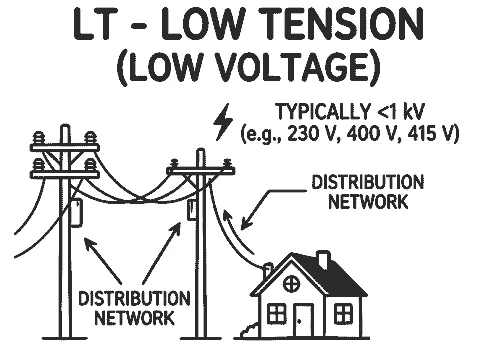
Generally, LT systems have a limited voltage level. Most standards limit this to approximately 1000 volts for AC and 1500 volts for DC. This is why LT supplies are considered safe and usable voltage levels for end consumers.
In practice, Low Tension supply is the same electricity we use in our daily lives. Homes, shops, small businesses, and many light industrial equipment are supplied with power at this voltage level. In India, a 230V Single Phase supply is typically provided for domestic use, and a 415V Three Phase supply for commercial and small-medium industrial use.
The main objective of LT electrical system is to ensure that consumers get electricity at safe, stable and usable voltage, so that domestic and commercial appliances can function properly without any risk.
Read more in Hindi: AC और DC करंट – परिभाषा, अंतर और उपयोग
HT Full Form in Electrical
HT Full Form in Electrical means High Tension. In electrical power systems, High Tension (HT) refers to those power systems in which electricity is transmitted and distributed at high voltage.
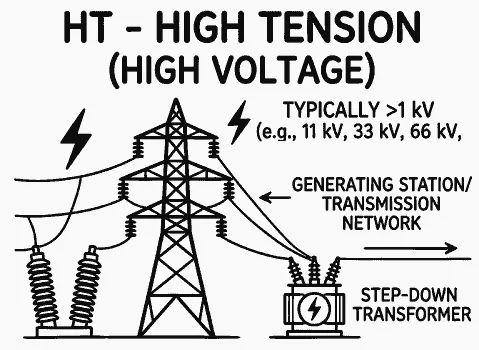
HT supplies typically have voltage levels exceeding 1000 volts. High voltages are used in power systems to transmit electricity over long distances, as this reduces power loss and allows for more efficient transmission.
In practice, high-tension electrical supplies are available at various voltage levels, such as 11 kV, 22 kV, 33 kV, 66 kV, 132 kV, and even higher. These voltage levels are used to transmit electricity from power plants to substations and then to large consumers.
HT systems are mainly used in power transmission lines, large industries, large commercial complexes and power substations, where high power capacity is required and power needs to be transmitted safely and efficiently over long distances.
Read more in Hindi: फेज सीक्वेंस – परिभाषा और व्याख्या
Why Is Electricity Transmitted at High Voltage? Explained Simply
High-voltage transmission is commonly used in electrical power systems to transmit electricity over long distances. The primary reason for this is to reduce energy loss and increase transmission efficiency.
According to electrical theory, when current passes through a wire, it experiences I²R loss (heat loss). This means that the higher the current, the greater the heat and energy loss in the wire. Therefore, in power systems, electricity is transmitted at high voltage and low current.
When voltage is increased, current decreases for the same power. This provides several important advantages, such as reduced line loss, improved transmission efficiency, and significantly reduced heat loss in the wires. Furthermore, the lower current allows the use of thinner and lighter conductors, which helps reduce transmission line costs.
After transmitting electricity over long distances, this high voltage is reduced using a transformer to a lower voltage (LT) for consumer use. This process makes modern electrical power transmission systems safer, more efficient, and more economical.
Read more in Hindi: एडी करंट लॉस – परिभाषा, सूत्र और ट्रांसफॉर्मर में हानि
Difference Between LT and HT Lines in Electrical Systems
In electrical power systems, HT supply is used to transmit power over long distances and handle large industrial loads, while LT supply is used to deliver power to consumers such as homes, shops and small industries.
The table below explains the key differences between LT and HT in a simple and clear manner.
| Speciality | LT (Low Tension) | HT (High Tension) |
|---|---|---|
| full form | Low Tension | High Tension |
| Voltage Range | About 1000V | More than 1000V |
| Main Uses | Homes, shops and small industries | Large industries and power transmission |
| Normal supply level | 230V Single Phase / 415V Three Phase | 11kV, 22kV, 33kV etc. |
| Security Level | Relatively safe and normal insulation is sufficient. | High safety and special insulation requirements |
| Distribution role | Delivering electricity to end consumers | long distance transmission of electricity |
Where Is LT Supply Used? Applications of Low Tension Electricity
LT Supply (Low Tension Supply) is primarily used in locations where electricity is required at voltages less than 1000 volts. It is the final stage of the power distribution system, from where electricity reaches consumers directly. LT power supplies, typically available in 230V single-phase and 415V three-phase, are used to power everyday appliances and machines. Below are the major uses of LT Supply:
1. Electricity supply to homes
The approximately 230V single-phase LT supply found in homes is used to run everyday appliances, such as lights, fans, refrigerators , TVs, wireless chargers , and air conditioners. Therefore, domestic power distribution is entirely based on a low-tension electrical system.
2. Commercial Building
Offices, shopping malls, hotels, and other commercial buildings typically use 415V Three-Phase LT Supply to power lighting systems , AC plants, elevators, and other electrical equipment.
3. Small and medium scale industries
Many industrial machines, pumps, and motors operate on 415V LT voltage. Small and medium-sized industries use LT electrical supplies to run conveyor belts, pumps, and various machinery.
4. Agriculture and irrigation
Water pumps and motors in agriculture often run on LT supplies. Many pumps used for irrigation on farms are based on 230V or 415V LT motor supplies.
Read more in Hindi: व्हीटस्टोन ब्रिज – सिद्धांत, सूत्र, आरेख और अनुप्रयोग
Where Is HT Supply Used? Applications of High Tension Electricity
HT supplies (High Tension supplies) are used where high voltages and high power capacity are required. Power with voltages typically exceeding 1000 volts is called HT supply. This supply is primarily used for power transmission, large industrial loads, and running heavy electrical equipment. Below are the major uses of HT supplies:
1. Large Industries
Large factories, steel plants, cement plants, and manufacturing units typically use 11kV or 33kV HT supplies to power heavy machinery and motors. This allows for the safe and efficient handling of large loads.
2. Power Transmission
HT transmission lines are used to transport electricity from power generation centers to cities and other areas. Sending electricity at higher voltages reduces power loss and makes it easier to transmit electricity over longer distances.
3. Power Substations
The HT power coming into the substation is converted to a lower voltage using a transformer. This power is then further distributed to consumers as LT supply.
4. Large commercial complexes and infrastructure
Locations like airports, metro stations, large shopping malls, hospitals, and high-rise buildings require more power. Therefore, HT electrical supplies are often used here to operate large loads stably and safely.
Read more in Hindi: कूलॉम्ब का नियम – परिभाषा और व्याख्या
What Is an LT Panel? Components and Uses
An LT Panel (Low Tension Panel) is an important electrical distribution panel used to distribute, control, and protect low-voltage electrical power. This panel typically operates at voltages below 1000 volts, such as 230V or 415V, and receives power from a transformer, generator, or mains supply.
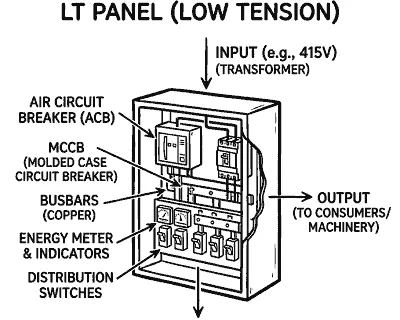
In simple terms, an LT Panel is a centralized control point of a power distribution system that divides incoming power into several different circuits and also provides protection to equipment from overloads, short circuits, and other electrical faults. This panel is usually mounted in a sturdy metal cabinet to ensure safe and orderly operation of all electrical equipment installed inside it.
The use of Low Tension Panel is very common in industrial plants, hospitals, shopping malls, commercial buildings and large residential societies, as it plays a vital role in maintaining stable, safe and controlled power supply.
Main Functions of an LT Panel in Electrical Systems
- Distributing electricity to different circuits
- Provides protection against overload and short circuit
- Monitoring voltage and current
- Ensuring safe operation of equipment and machinery
Major equipment used in LT Panel
- MCB (Miniature Circuit Breaker)
- MCCB (Molded Case Circuit Breaker)
- Contactor
- Relay
- Busbar
- Metering Devices
Read more in Hindi: फ्लेमिंग का बायाँ हाथ नियम – परिभाषा और व्याख्या
What Is an HT Panel? Definition, Components
An HT Panel (High Tension Panel) is a high voltage electrical switchgear panel used to control, distribute and protect electricity exceeding 1000 volts. Typically this panel operates at voltage levels such as 11kV, 22kV or 33kV and is mainly installed in substations, large industries and large commercial complexes.
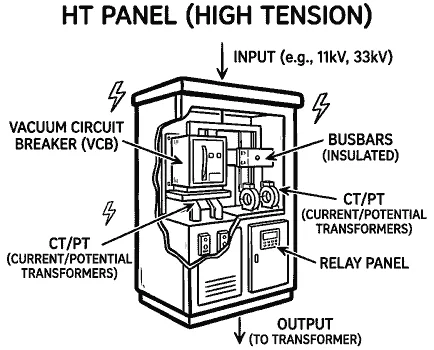
In simple terms, HT Panel is that part of the power distribution system that controls the incoming high voltage supply and helps protect the system and equipment in case of any overload, short circuit or fault. This panel is usually housed in a sturdy metal enclosure that houses several important switchgear and protection devices.
The primary function of a high-tension panel in a power distribution network is to safely switch on/off, monitor, and route high-voltage power to transformers or other systems. This is why it is considered extremely important for the safety and reliable operation of large electrical systems.
Main components of HT Panel
- Vacuum Circuit Breaker (VCB)
- Isolator
- Protection Relay
- Current Transformer (CT)
- Potential Transformer (PT)
- Busbar
The main purpose of HT Panel is to manage high voltage power in a safe, controlled and reliable manner, so that the power supply to large industries and power systems can continue smoothly without any danger.
Read more in Hindi: फ्लेमिंग का दायाँ हाथ नियम – सिद्धांत और उदाहरण
What Do HT and LT Mean in a Transformer?
The terms HT (High Tension) and LT (Low Tension) in a transformer refer to the input and output voltage levels of electricity. In simple terms, the side of the transformer where high voltage electricity enters is called the HT side, and the side where low voltage electricity exits is called the LT side.
Transformers are typically used in power distribution systems to convert high voltage to low voltage. For example, an 11kV or 33kV HT supply comes into a transformer and the transformer steps it down to approximately 415V or 230V LT supply, so that this power can safely reach homes, shops, and small industries.
Correct connection and insulation of HT and LT ends in a transformer is very important, as the voltage on the HT side is very high while the LT side is at a safe level for consumer use. Therefore, transformers are an important device in power systems that bridge between high voltage transmission and low voltage distribution.
Read more in Hindi: सेमीकंडक्टर – परिभाषा, प्रकार, उदाहरण और उपयोग
Frequently Asked Questions (FAQs)
Question 1. What is the full form of LT in Electrical?
In electrical systems, LT stands for Low Tension. It refers to power supplies delivered to consumers at low voltage levels. LT supplies are typically rated up to 1000 volts and are used in homes, shops, offices, and small industries. In India, 230V single-phase and 415V three-phase power supplies typically fall under the Low Tension (LT) system.
Question 2. What is the full form of HT in electrical?
In electrical systems, HT stands for High Tension. It refers to power supplies that are transmitted or distributed at high voltage levels (over 1000 volts). HT systems typically include supplies such as 11kV, 22kV, and 33kV.
Question 3. What is the difference between LT and HT?
The main difference between LT (Low Tension) and HT (High Tension) power supplies is their voltage level and purpose. LT supplies are up to 1000 volts and are used in homes, shops, small industries, and commercial buildings. In contrast, HT supplies are above 1000 volts and are used in power transmission, large industries, substations, and large commercial premises.
Question 4. Which supply comes to the house: LT or HT?
Homes receive LT (Low Tension) power supply. This is typically 230V single-phase or, for smaller apartments/commercial use, 415V three-phase voltage. The primary purpose of LT supply is to provide safe and stable power to household appliances such as lights, fans, TVs, refrigerators, and chargers. HT (High Tension) supply is used only for large industries and transmission lines, so it doesn’t reach homes directly.
Question 5. What is the difference between LT Panel and HT Panel?
Both LT Panel (Low Tension Panel) and HT Panel (High Tension Panel) are important components of power distribution, but there is a clear difference in their function and voltage level.
LT Panel: Operates at voltages of 1 kV (1000V) or less. Primarily used for power distribution, control, and protection in homes, small industries, and commercial buildings. It includes devices such as MCBs, MCCBs, contactors, relays, and busbars. The purpose of an LT Panel is to deliver safe and stable power to consumers.
HT Panel: Operates at voltages greater than 1 kV, such as 11 kV or 33 kV. Primarily used to control and protect high-voltage power in large industries, power substations, and long-distance transmission networks. It includes devices such as a Vacuum Circuit Breaker (VCB), Isolator, Protection Relay, Current Transformer, and Potential Transformer.
Conclusion
LT (Low Tension) and HT (High Tension) are two important parts of an electrical power system. HT is used to transmit electricity over long distances efficiently, while LT is used to supply electricity at a safe voltage to homes, shops, and small industries.
In simple words, HT carries power over long distances, and LT delivers it safely to end users. Both systems work together to ensure smooth and efficient power distribution.
Understanding the full form of LT and HT and the difference between them helps you build a strong basic understanding of electrical power systems. It also makes it easier to understand how electricity is transmitted and distributed in real life.
