
Have you ever wondered how machines in factories work automatically without human control? If you are starting your journey in industrial automation, you will often hear about PLCs. But many beginners still ask, “What is a PLC in electrical, and why is it so important?” Don’t worry—it’s simpler than it sounds. In this guide, you will learn the basics of PLC, how it works, its types, and its applications in a clear and easy-to-understand way.
Table of Contents
What Is a PLC (Programmable Logic Controller)?
A Programmable Logic Controller (PLC) is a special type of industrial computer used to control machines and processes automatically. In simple terms, if you want machines to work without constant human effort, a PLC is the brain behind that automation.
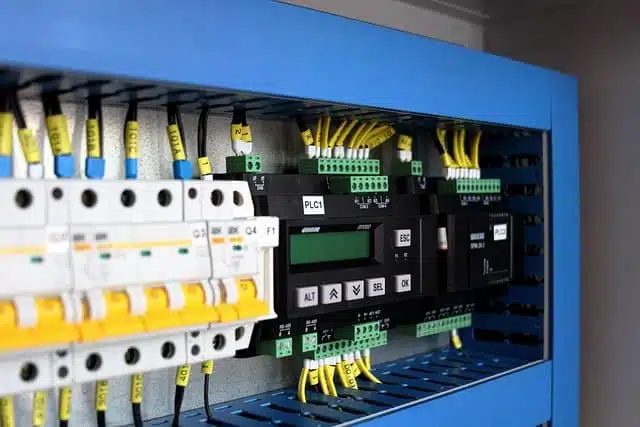
PLC stands for Programmable Logic Controller. It is designed to handle electromechanical processes in industries like manufacturing, power plants, and automation systems. Because of this, it is sometimes also called an industrial computer.
But a PLC does more than just control. It also continuously monitors machines, collects data, and helps in detecting faults. In modern industries, PLCs can send information from factory machines to central systems, allowing engineers to monitor and control operations even from remote locations.
Learn More: What is a Voltmeter
What Is the Purpose of a PLC?
The main purpose of a PLC is to automatically control machines and industrial processes in an easy and efficient way. In the past, industries used relay-based systems, which were complicated, slow, and difficult to change. PLCs replaced these systems by using simple programming instead of heavy wiring.
A PLC takes input from devices like sensors and switches, processes the information, and controls outputs such as motors and valves instantly. It is very reliable, works well in tough industrial conditions, and can be easily updated when needed. PLCs also help improve safety, reduce human errors, and can connect with systems like SCADA and HMI for better monitoring and control.
How Does a PLC Work?
A PLC works in a simple and continuous process made up of three main stages: input, processing, and output. This cycle runs again and again very quickly (in milliseconds), which helps machines operate smoothly and automatically without stopping.

1. Input Stage
In this stage, the PLC collects data from connected devices like sensors, switches, and push buttons. These inputs tell the PLC what is happening in the system.
There are two main types of inputs:
- Digital inputs – Only ON or OFF (like a light switch)
- Analog inputs – Continuous values (like temperature, speed, or pressure)
Inputs can come automatically from machines or from operators using systems like HMI or SCADA.
2. Program Execution
After receiving the input data, the PLC’s CPU (brain) processes it using a program written by the user. This program contains logical instructions that decide what action should be taken.
For example, if a sensor detects a low level in a tank, the program can decide to start a pump. The PLC compares the input conditions and makes decisions instantly.
3. Output Stage
Once the decision is made, the PLC sends signals to output devices such as motors, valves, heaters, alarms, or indicator lights. These outputs perform the actual physical work in the system.
For example, turning ON a motor, opening a valve, or activating an alarm.
Continuous Scan Cycle (Very Important)
After completing all three steps, the PLC performs a quick internal check to ensure everything is working properly. Then it immediately starts the cycle again. This continuous loop is called the scan cycle, and it happens in milliseconds. Because of this, PLCs can respond very fast to changes and keep the system running efficiently and safely.
Learn More: What is a Potential Transformer
Basic Components of a PLC
A PLC system is made up of several important parts, and each part has a specific role. All these components work together to control machines and automation processes smoothly.
Power Supply
The power supply provides the energy needed for the PLC to operate. It usually converts AC power into DC power because most PLC components work on DC. Without a proper power supply, the PLC cannot function.
CPU (Central Processing Unit)
The CPU is the brain of the PLC. It controls all operations by reading input signals, processing them using the program, and sending commands to output devices. All decision-making happens inside the CPU.
I/O Modules (Input and Output)
I/O modules connect the PLC to real-world devices.
- Input modules receive signals from sensors, switches, and push buttons.
- Output modules send signals to motors, valves, lights, and relays.
These modules allow the PLC to interact with machines and processes.
Memory (ROM & RAM)
Memory is used to store programs and data in the PLC.
- ROM (Read Only Memory) stores permanent system data.
- RAM (Random Access Memory) stores user programs and temporary data.
Memory helps the PLC remember instructions and perform tasks correctly.
Programming Device
A programming device is used to create and upload the PLC program. It is usually a computer or laptop with special software. Engineers use it to write logic, test programs, and transfer them to the PLC.
Communication System
The communication system allows the PLC to connect with other systems like SCADA, HMI, or other PLCs. It helps in monitoring, controlling, and sharing data, even from remote locations.
Learn More: RCCB Full Form in Electrical
What Are the Main Types of PLCs?
When you work with PLCs, you’ll notice that different situations need different types of PLCs. Some are made for small machines, while others are built for large and complex industrial systems. Let’s understand them in a Easy way.

Compact PLC (All-in-One Type)
Compact PLC comes as a complete unit where all the essential components like the CPU, power supply, and input/output modules are already built inside, so you don’t need to add any extra parts. Because of this, it is very easy to install, simple to operate, and perfect for beginners who are just starting with automation. It is commonly used in small machines and basic control tasks, as it is cost-effective and reliable for simple applications.
However, one drawback is that its capacity cannot be expanded later, so it may not be suitable for systems that need to grow or require more inputs and outputs in the future.
Modular PLC (Flexible Setup)
A modular PLC is made of separate parts, so you can connect different modules like the CPU, input/output modules, and power supply based on your needs. This makes it very flexible and easy to set up for different systems.
The biggest benefit is that you can expand it anytime-if your system grows, you just add more modules instead of changing the whole PLC. Because of this, modular PLCs are a smart and cost-effective choice for industries that may need future upgrades or changes.
Rack-Based PLC (For Large Systems)
Rack-based PLCs are used when the system is large and complex. All the parts (modules) are placed in a rack, and each one has its own slot, which keeps everything neat and easy to manage. It can handle many inputs and outputs and can control multiple machines at the same time. Because it is powerful and reliable, it is mostly used in big factories and large industrial plants.
Distributed PLC System (Network Control)
In this type of setup, control is shared between multiple PLCs instead of using just one single unit. All these PLCs are connected through a network and work together as a team to control different parts of the system. This makes it very useful for large plants where machines are spread over a wide area.
It also reduces the need for too much wiring, which makes installation easier. Another big advantage is reliability—if one PLC stops working, the other PLCs can still continue running the system, so the whole process does not stop.
Learn More: What is MCCB in Electrical
What Are Digital and Analog Inputs/Outputs in PLC
In a PLC system, signals are used for communication between machines and the controller. These signals help the PLC understand what is happening and what action to take. There are mainly two types of signals: digital and analog.
Digital Signals (Discrete Signals)
Digital signals are the simplest type of signals. They have only two states: ON or OFF. There is nothing in between these two conditions. These signals are used with devices like push buttons, switches, and simple sensors. For example, a start button is either pressed (ON) or not pressed (OFF).
You can understand digital signals like a normal light switch—it is either ON or OFF.
Analog Signals (Continuous Signals)
Analog signals are different because they can have many values, not just two. These signals change continuously over a range. They are used to measure things like temperature, pressure, speed, or liquid level. For example, temperature can be 25°C, 30°C, 45°C, and so on.
You can think of analog signals like a dimmer switch—you can adjust it from low to high, not just ON or OFF.
What Are the Most Standard PLC Programming Languages?
One of the best things about PLCs (Programmable Logic Controllers) is that they are easy to program, even for beginners. To make programming simple and flexible, PLCs use different standard programming languages. Each language is designed for a different type of user and application, but all of them can be used to control machines effectively.
Ladder Logic (Best for Beginners)
Ladder Logic is the most popular and widely used PLC programming language. It looks very similar to electrical wiring diagrams, which makes it easy for electricians and beginners to understand.
Instead of writing complex code, it uses simple symbols and lines to create logic. Because of its simplicity and easy troubleshooting, it is commonly used in industries for fast and reliable programming.
If you are new to PLC, Ladder Logic is the best language to start with.
Function Block Diagram (FBD)
Function Block Diagram (FBD) uses blocks to represent different functions like timers, counters, and logic operations. These blocks are connected together to build a complete control system.
It is very useful for processes that need calculations or repeated operations. Many engineers like FBD because it is visual, easy to read, and well-organized.
Structured Text (ST)
Structured Text is a text-based programming language, similar to languages like C or Python. It is used for writing complex logic, calculations, and advanced control tasks.
This language is very powerful, but it requires some programming knowledge. That’s why it is mostly used by experienced programmers and engineers.
Sequential Function Chart (SFC)
Sequential Function Chart (SFC) is used for processes that follow a step-by-step sequence. It helps in designing systems where actions happen in order, one after another. This makes it very useful in industries like manufacturing, where machines follow a fixed sequence of operations.
Instruction List (IL)
Instruction List is a simple, low-level programming language that works like basic commands. It was used in older PLC systems, but nowadays it is rarely used because modern languages like Ladder Logic and Structured Text are easier and more powerful.
Learn More: What Is an Ammeter
Benefits of Using PLCs
In the past, industries used relay-based systems to control machines. These systems were difficult to understand and very hard to change. With PLCs, things became much easier. If you want to make any changes, you don’t need to do wiring again — you can simply update the program. This saves time and makes the system more flexible.
PLCs are also very strong and reliable. They do not have moving parts, so they can work for a long time without much maintenance. They are specially designed to work in tough conditions like heat, dust, and vibration, which makes them very dependable in industries.
Another big advantage of PLCs is better control and monitoring. A PLC can control many devices at the same time and handle complex tasks easily. It also helps you check the system performance in real time, which improves efficiency and helps industries work faster and more accurately.
PLC in SCADA and HMI Systems
In modern industries, PLCs work together with SCADA and HMI systems to make control and monitoring easy. The PLC controls the machines, while SCADA and HMI show everything on a screen so operators can see and manage the process.

A PLC works like a link between machines and software. It collects data from devices like sensors and motors and sends this data to SCADA or HMI screens. It also receives commands from these systems and performs actions like starting a motor, changing temperature, or running a conveyor.
With this setup, operators can see real-time data, check system performance, and control machines from one place. This makes the system easy to use, more efficient, and very helpful for managing large industrial processes.
How to Use PLCs With the IIoT (Industrial Internet of Things)
In today’s industries, PLCs are not just used to control machines in one place. By connecting them with IIoT, you can make your system smart and connected.
First, the PLC collects data from machines and devices like sensors. This data can be temperature, speed, pressure, or machine status. Instead of keeping this data only inside the system, it is sent to the cloud or a central server where it can be stored and used later.
To make this communication fast and efficient, modern PLCs use technologies like MQTT. This sends data only when needed, which saves internet usage and works well even in remote areas. If you are using older PLCs, you can use edge devices or gateways. These devices help send data from the PLC to the cloud easily.
By using PLCs with IIoT, industries can check their machines from anywhere, get live updates, and make better decisions using real data. This helps improve efficiency, reduce machine downtime, and create smarter automation systems.
Learn More: LT and HT Full Form in Electrical
Future of PLC (Programmable Logic Controller)
The future of PLCs is very bright because industries are becoming smarter and more connected. Earlier, PLCs worked alone, but now they are becoming part of modern systems like smart factories and digital manufacturing.
New technologies like Programmable Automation Controllers (PACs) are making PLC systems more powerful and flexible. Also, with the help of AI and IoT, PLCs can now do more than just control machines — they can also help in analyzing data and making better decisions.
Another big improvement is in communication. Modern PLCs can easily connect with cloud systems, networks, and other smart devices. This makes it possible to monitor and control machines from anywhere.
Even with all these new changes, PLCs are still very popular because they are easy to use, cost-effective, and highly reliable. That’s why PLCs will continue to be an important part of industrial automation in the future.
How is a PLC Programmed?
Programming a PLC means telling it how to control a machine or process. It is simple and easy to learn, even for beginners.
First, a program is created on a computer using PLC software. This program decides what action to take based on inputs. For example, if a button is pressed, the PLC can start a motor. Most programs are written in simple languages like Ladder Logic.
After creating the program, it is uploaded to the PLC using a cable or network. The PLC then runs this program continuously. It checks inputs, processes the logic, and controls outputs very quickly.
If any changes are needed, the program can be updated easily without changing the wiring. This makes PLCs flexible and efficient for industrial automation.
Learn More: What is Plate Earthing
Frequently Asked Questions (FAQs)
Question 1. What is PLC in simple words?
A PLC (Programmable Logic Controller) is a small industrial computer that controls machines automatically. It takes input from sensors, processes it, and gives output to devices like motors and valves.
Question 2. What is the full form of PLC In Electrical?
PLC stands for Programmable Logic Controller. It is used in industries to automate and control different processes.
Question 3. What is the use of PLC in automation?
PLCs are used in automation to control machines without human effort. They improve efficiency, reduce errors, and save time in industrial processes.
Question 4. What is the difference between PLC and SCADA?
PLC is a hardware device used to control machines, while SCADA is software used to monitor and control systems from a central location.
Question 5. What is the difference between PLC and DCS
A PLC is used for controlling individual machines and fast operations, while a DCS is used for large, complex processes with centralized control.
Conclusion
A PLC is an important device used to automate and control machines in industries. Understanding what is a PLC in electrical helps you know how machines work automatically using simple programming.
PLCs have made automation faster, easier, and more reliable than old systems. With the growth of smart technologies, PLCs will continue to play a key role in modern industries.