
In electrical engineering, high voltage cannot be measured directly because it is dangerous. So, instrument transformers are used to reduce voltage to a safe level.
PT full form in electrical is Potential Transformer. It converts high voltage into low voltage so that meters and relays can measure it safely and accurately.
In this guide, you will learn about Potential Transformer, its construction, and working in simple language.
Table of Contents
PT Full Form in Electrical
In electrical engineering, PT Full Form in Electrical stands for Potential Transformer.
PT = Potential Transformer
A PT device is a specially designed instrument transformer that helps measure high voltage in a safe and accurate way. Instead of measuring high voltage directly, it reduces the voltage to a lower, standard value that measuring devices can handle easily.
For example, a high voltage of 11 kV can be stepped down to 110 V, allowing voltmeters, relays, and other metering instruments to work safely and correctly.
What is a Potential Transformer (PT)?
A PT device is an instrument transformer used to convert high voltage in a power system into a lower, safer voltage. This makes it easy for measuring instruments like voltmeters, relays, and meters to measure voltage without any risk.
Measuring high voltage directly is dangerous, so a PT is used as a safe solution.
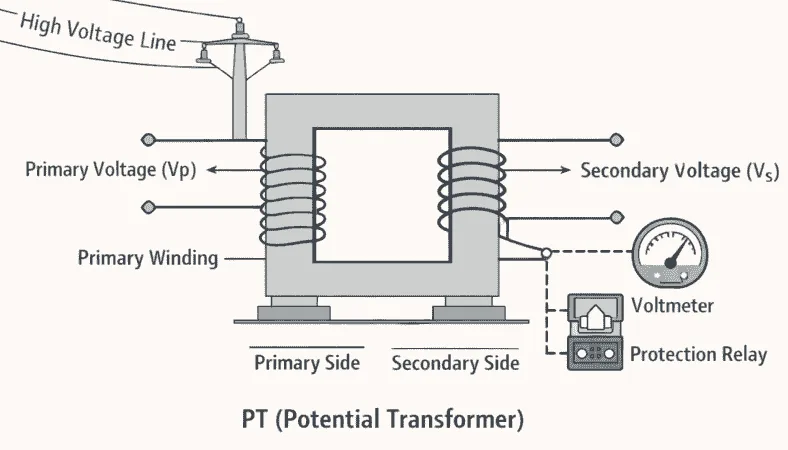
Definition: A Potential Transformer is a device that steps down high voltage into a proportional low voltage while maintaining accuracy for measurement.
In simple words, a PT works like a step-down transformer. It takes high voltage from the power line and reduces it to a standard value (such as 110 V or 63.5 V), which can be safely used by measuring and protection devices.
In a power system, a PT is always connected in parallel with the line. Even though it reduces the voltage, it keeps the voltage ratio and phase almost the same, ensuring accurate readings.
Learn More: What is a Voltmeter
Diagram of Potential Transformer (PT)
This diagram shows a simple view of how a Potential Transformer (PT) works.
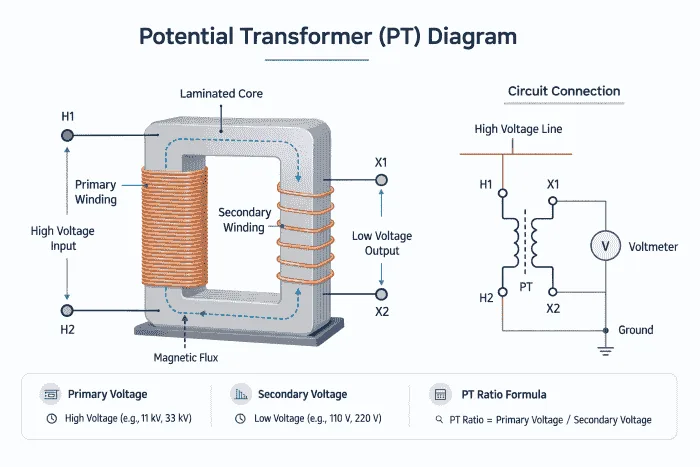
The primary winding, shown on the left side, is connected to the high-voltage line. This is where the transformer receives the high voltage as input. Inside the transformer, this voltage is transferred to the secondary winding through magnetic induction.
On the right side, the secondary winding gives a much lower and safer voltage as output. This reduced voltage is then supplied to devices like voltmeters and protection relays.
PT Symbol in Electrical Diagram
In electrical diagrams, a PT device is shown using a special symbol. This symbol helps engineers and technicians quickly identify where the PT is connected and how it supplies voltage to measuring devices.
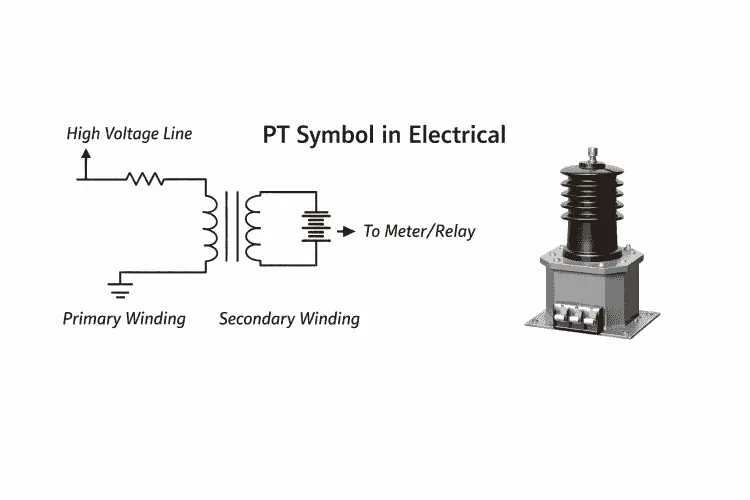
The PT symbol usually looks like a small transformer. It shows the primary side connected to the high-voltage line and the secondary side connected to instruments like voltmeters or protection relays. This clearly indicates that the transformer is used to step down voltage for safe measurement.
Main parts of a PT symbol:
- Transformer Symbol – Shows that a transformer is used
- Primary Connection – Connected to the high-voltage line
- Secondary Output – Connected to meters, relays, or other devices
Learn More: RCCB Full Form in Electrical
Construction of Potential Transformer (PT)
A PT device is built like a normal transformer, but it is specially designed for accurate and safe voltage measurement. Its main job is to step down high voltage to a fixed, lower value, so measuring instruments can work properly.
The main parts of a PT device are explained below in simple language:
Core
The core is the heart of the PT. It is made of laminated silicon steel, which helps reduce energy loss and allows magnetic flux to flow easily. This is where the voltage transformation takes place.
Primary Winding
The primary winding is connected to the high-voltage line. It usually has more turns and is designed to handle high voltage safely. It is made of copper or aluminum and is well insulated.
Secondary Winding
The secondary winding provides low and safe voltage output. It has fewer turns compared to the primary winding. This output is given to devices like voltmeters, relays, and meters for accurate measurement.
Insulation
Since PTs work with high voltage, strong insulation is very important. Materials like paper, resin, or transformer oil are used to protect the windings and prevent faults like leakage or short circuits.
Tank
In larger PTs, the core and windings are placed inside a metal tank. This tank is often filled with transformer oil, which helps in cooling and provides extra insulation.
Terminals
Terminals are used to connect the transformer. The primary terminals connect to the high-voltage line, while the secondary terminals connect to measuring and protection devices.
Learn More: What is MCCB in Electrical
Potential Transformer (PT) Working Principle
The working principle of a Potential Transformer (PT) is based on electromagnetic induction (mutual induction).
When the primary winding of a PT is connected to a high-voltage AC supply (like 11 kV or 33 kV), current flows through it and creates an alternating magnetic field in the transformer core. This magnetic field then passes to the secondary winding.
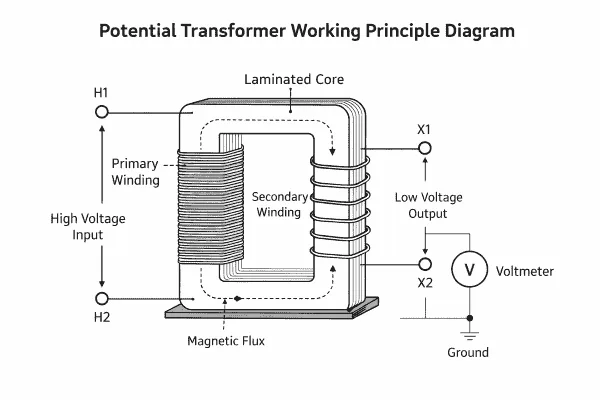
As a result, a voltage (EMF) is induced in the secondary winding according to Faraday’s Law. Since the secondary winding has fewer turns, the voltage produced is much lower than the input voltage.
The output voltage depends on the turns ratio of the transformer. For example, in a 33,000 V / 110 V PT, a high voltage of 33 kV is reduced to about 110 V.
This low voltage is then safely given to voltmeters, relays, and other measuring devices.
Learn More: What Is an Ammeter
What is Potential Transformer Ratio? | PT Ratio Formula and Example
The PT device Ratio shows the relationship between the primary voltage and the secondary voltage. It tells us how much the high voltage is reduced to a lower, safe value for measurement.
In simple terms, the PT ratio indicates how many times the primary voltage is greater than the secondary voltage.
PT Ratio Formula
PT Ratio = Primary Voltage / Secondary Voltage
or
PT Ratio = Vp / Vs
Where:
- Vp = Primary Voltage
- Vs = Secondary Voltage
Let’s understand with a simple example:
- Primary Voltage (Vp) = 11,000 V
- Secondary Voltage (Vs) = 110 V
- PT Ratio = 11000 / 110 = 100
This means the primary voltage is 100 times higher than the secondary voltage. So, the PT reduces 11 kV to 110 V, making it safe and easy to measure.
Usually, the secondary voltage of a PT is kept at standard values like 110 V or 63.5 V, so that measuring instruments can work safely and accurately.
Learn More: LT and HT Full Form in Electrical
Types of Potential Transformer (Types of PT)
PT devices are used in different types of power systems, so they are designed in different forms based on voltage level and application. Mainly, there are two common types of PTs:
Electromagnetic Potential Transformer
This is the most widely used type of PT. It is built like a normal transformer, with a magnetic core, primary winding, and secondary winding.
The primary winding is connected to the high-voltage line, and the secondary winding is connected to measuring devices like voltmeters and relays. Since the primary has more turns and the secondary has fewer turns, the voltage is reduced in a fixed ratio.
This type is mainly used in low and medium voltage systems because it is simple, reliable, and provides accurate results.
Capacitive Potential Transformer (CVT)
A Capacitive Potential Transformer (CVT) is used in high and extra high voltage systems.
Instead of reducing voltage directly like a normal transformer, it first uses a capacitor divider to lower the voltage. After that, an auxiliary transformer further reduces the voltage to a safe level.
CVTs are commonly used in transmission lines of 110 kV and above, as they are more economical and practical for very high voltages.
Learn More: What is Plate Earthing and How is it Done
Phasor Diagram of Potential Transformer (PT)
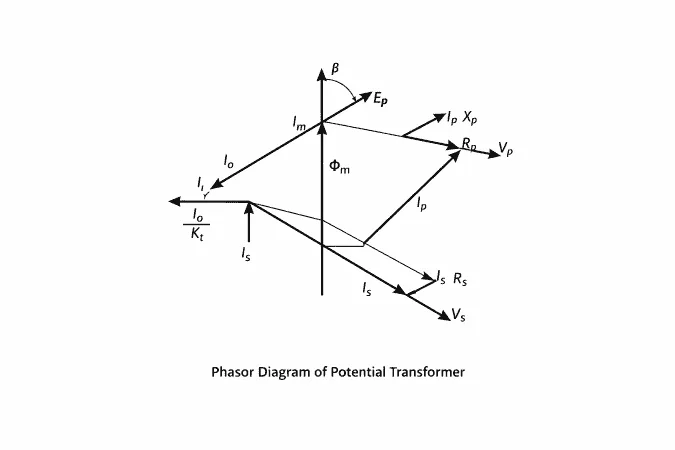
The phasor diagram of a PT device shows the phase relationship between voltage, current, and magnetic flux inside the transformer. It helps us understand how these quantities behave and why a PT gives accurate measurements.
In this diagram, the main magnetic flux (Φm) is taken as the reference. When the primary voltage (Vp) is applied, a primary current (Ip) flows in the primary winding. This current produces an alternating magnetic flux in the core.
Due to the resistance (Rp) and reactance (Xp) of the primary winding, a small voltage drop occurs (shown as IpRp and IpXp). After these drops, the induced EMF in the primary (Ep) is produced.
This EMF is then transferred to the secondary winding through magnetic induction, creating the secondary EMF (Es). On the secondary side, there are also small drops due to resistance (Rs) and reactance (Xs), and finally we get the secondary voltage (Vs).
The diagram also shows the excitation current (Io), which has two parts:
- Im – helps in producing magnetic flux
- Iw – represents core losses
There is also a small angle called phase angle error (β), which shows the slight difference between primary and secondary voltages.
Applications of Potential Transformer (PT)
A PT device is widely used in power systems to convert high voltage into a safe, low voltage. This low voltage is then used by different devices for measurement, protection, and control.
Here are the main uses of a PT:
- High Voltage Measurement: PTs are used to measure the voltage of high-voltage lines. They step down the voltage to a standard level (like 110 V or 63.5 V), so it can be safely measured using a voltmeter.
- Metering System: PTs provide accurate voltage to metering devices such as voltmeters, wattmeters, and energy meters. This ensures correct measurement of electricity consumption and proper billing.
- Protection System: In power systems, protective relays need accurate voltage signals to detect faults. PTs supply a safe voltage to these relays, helping them operate circuit breakers during conditions like overvoltage or undervoltage.
- Substation Monitoring: PTs are used in substations for continuous voltage monitoring. This helps operators keep track of system performance and maintain proper voltage levels.
- Power System Analysis: Engineers use PTs to study and analyze the power system. It helps in checking voltage stability, power quality, and overall system performance.
What is the difference between a PT and a CT? (Potential Transformer vs Current Transformer)
In power systems, instrument transformers are used to measure high voltage and current safely. The two most important types are PT (Potential Transformer) and CT (Current Transformer). Many students and technicians often want to clearly understand the difference between these two devices.
In simple terms, a PT is used to measure voltage, while a CT is used to measure current. Both devices reduce high electrical values (voltage or current) to a lower and safer level, so that meters, relays, and protection devices can work properly without any risk.
The table below will help you understand the key differences between PT and CT in a simple and clear way.
| Feature | PT (Potential Transformer) | CT (Current Transformer) |
|---|---|---|
| Full name | Potential Transformer | Current Transformer |
| what does it measure | Voltage | Current |
| Connection Type | Parallel | Series |
| Output | Low Voltage | Low Current |
| Use | Voltage Measurement | Current Measurement |
Advantages and Disadvantages of Potential Transformer (PT)
In high-voltage systems, safety and accuracy are very important. A PT device helps achieve both by providing a safe way to measure voltage.
Advantages of PT
- Easy High Voltage Measurement: PT makes it possible to measure very high voltage safely by converting it into a low, standard value.
- Protection of Instruments: It protects sensitive devices like voltmeters and relays by supplying them with reduced and safe voltage.
- High Accuracy: PTs are designed for precise measurement, so they provide very accurate voltage readings.
- Supports Protection System: PT supplies proper voltage signals to protective relays, helping them detect faults and operate circuit breakers.
- Electrical Isolation: It provides isolation between high-voltage circuits and measuring devices, improving safety for both equipment and users.
Disadvantages of PT
- Higher Cost: Due to better insulation and design, PTs are more expensive than normal transformers.
- Installation Complexity: Proper installation requires technical knowledge, especially in high-voltage systems.
- Regular Maintenance Needed: PTs need periodic inspection and maintenance to ensure safe and efficient operation.
What are the Important Factors in PT Selection?
Choosing the right Potential Transformer (PT) is very important for getting accurate voltage readings and ensuring proper protection of the power system. Engineers select a PT carefully based on a few key factors.
- Voltage Rating: The primary voltage of the PT should match the system voltage where it will be used. This ensures safe and correct voltage conversion.
- Accuracy Class: The accuracy class shows how precise the PT is. Higher accuracy is required for metering, while protection systems may use different accuracy levels.
- Burden (VA Rating): All connected devices like meters and relays create a load on the PT. The PT should have enough VA rating to handle this load without affecting performance.
- Insulation Level: Since PTs work in high-voltage conditions, strong insulation is necessary. It protects the transformer from faults, leakage, and voltage surges.
- Frequency Rating: The PT should match the system frequency, which is usually 50 Hz or 60 Hz. This ensures proper and stable operation.
What are PT Safety Precautions?
A PT device works directly with high-voltage lines, so following proper safety precautions is very important. These precautions help protect the transformer, connected equipment, and the person working on it.
Never Short-Circuit the Secondary
The secondary winding of a PT should never be short-circuited. It can damage the transformer and affect connected devices. Always keep the secondary circuit properly connected.
Ensure Proper Grounding
The secondary side of the PT must be properly grounded. This improves safety and protects against unexpected voltage or faults.
Use Fuse Protection
Fuses should be used with a PT to protect it from faults. If any abnormal condition occurs, the fuse will disconnect the circuit and prevent damage.
Avoid Overloading
Always operate the PT within its rated capacity. Overloading can cause overheating and reduce the life of the transformer.
Frequently Asked Questions (FAQs)
Question 1. What is the full form of PT?
The full form of PT is Potential Transformer. It is an electrical device used to convert high voltage into a lower and safer voltage level. This helps in measuring voltage easily and safely using meters and also supports protection systems in power networks.
Question 2. Where is a Potential Transformer used?
A PT device is used in electrical systems to measure and monitor high voltage safely. It reduces high voltage to a lower, safe level so that meters and protection devices can work properly.
PTs are mainly used in power substations, power plants, transmission lines, and electrical protection systems. They help provide accurate voltage readings and protect equipment from high voltage.
Question 3. How is a Potential Transformer (PT) connected in the circuit?
A PT device is connected in parallel in a circuit. It is connected across the line whose voltage needs to be measured.
This parallel connection allows the PT to take the high voltage from the line and convert it into a lower, safe voltage. This lower voltage can then be easily measured by a voltmeter or other measuring devices.
Question 4. What is the difference between Potential Transformer and Power Transformer?
A Potential Transformer (PT) is used for voltage measurement and protection, while a Power Transformer is used for transmitting and distributing electrical power.
In simple words:
PT → Measurement
Power Transformer → Power transfer
Question 5. How to test a Potential Transformer (PT)?
A PT device can be tested by checking its performance, accuracy, and insulation.
Visual Check: Look for any physical damage, loose connections, or oil leakage.
Insulation Test: Check insulation resistance to ensure safety.
Ratio Test: Verify the PT ratio by comparing primary and secondary voltage.
Polarity Test: Ensure correct polarity connection.
Voltage Test: Apply voltage and check if the output is correct.
Conclusion
A Potential Transformer (PT) is an essential device in power systems that safely converts high voltage into a low, measurable value. This makes voltage measurement easy and protects instruments from direct exposure to high voltage.
If you understand the PT Full Form in Electrical, which is Potential Transformer, it becomes easier to see its importance in real-world applications. PTs not only provide accurate voltage readings but also support protection systems by supplying the correct signals to relays.
Because of these benefits, PTs are widely used in substations, transmission lines, and other high-voltage systems to ensure safe, reliable, and efficient operation.