
In physics and electronics, understanding how much electric current flows through a circuit is very important. It helps us know whether a circuit is working properly or not. To measure this current, we use a special instrument called an ammeter.
But have you ever thought about what is an ammeter, how it works, and why it is connected in a particular way in a circuit?
In this guide, we will learn about what is an ammeter, its definition, working principle, types, correct connection, and uses—all explained in a simple and easy-to-understand way.
Table of Contents
What is an ammeter?
Definition of Ammeter: An ammeter is an important electrical measuring instrument used to measure the amount of electric current flowing in a circuit . It measures current in the standard unit ampere, hence it is called an ammeter or ampere meter.
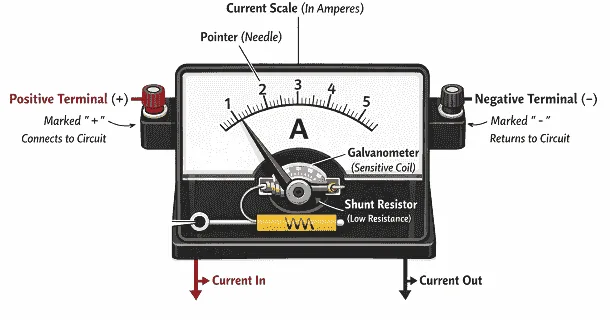
In simple words, an ammeter is a device that measures how much electric current is flowing in a circuit. This helps us understand whether a circuit is working properly or not.
Over time, ammeters have become more accurate and reliable. Today, they come in two main types: analog ammeters, which show the reading with a needle, and digital ammeters, which display the current clearly on a screen.
Ammeter diagram
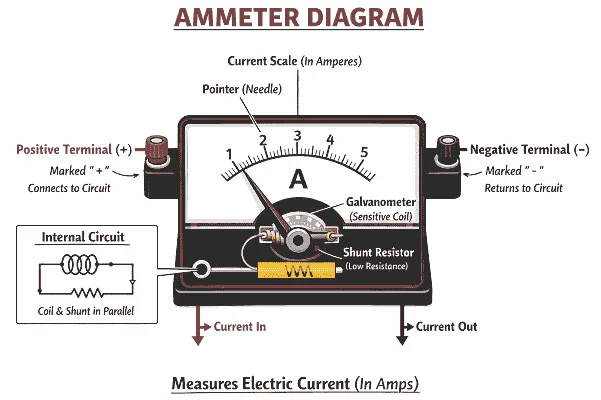
This diagram shows an ammeter, which is used to measure electric current. It has a scale (0–5 A) at the top, on which a needle (pointer) moves to indicate the current. An ammeter has two terminals—positive (+) and negative (−), through which current flows in and out.
It consists of a galvanometer that moves the needle, and a shunt resistor that protects the instrument by diverting excess current. Ammeters are always connected in series in a circuit to ensure accurate current measurement.
Read more in Hindi: वोल्टमीटर क्या होता है?
Symbol of an Ammeter
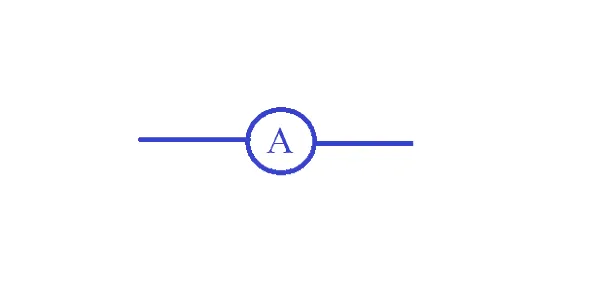
The ammeter symbol is a simple symbol used to represent a current-measuring device in an electrical circuit diagram. It is usually shown as the letter A , which stands for Ampere, within a circle. This symbol indicates that the ammeter is connected to that part of the circuit where the current is being measured.
What is the Function of an Ammeter?
The main function of an ammeter is to accurately measure the current flowing in an electrical circuit. It measures the current in amperes (A) and displays it on a scale or digital display, allowing accurate assessment of the circuit’s condition and performance.
Whenever current flows through a circuit, an ammeter measures that current and displays its value immediately. This measurement is extremely useful not only in the laboratory but also for testing machines, motors , and electronic devices.
Read More In Hindi: वैक्यूम सर्किट ब्रेकर क्या होता है?
Why is the ammeter connected in series?
Ammeters are always connected in series, and there is a clear scientific reason behind this.
To measure current, it is necessary that all of the current flowing in the circuit passes through the ammeter. When an ammeter is connected in series, it becomes part of the circuit and the current for the entire circuit flows through that path. This allows the ammeter to make accurate and precise measurements.
The internal resistance of an ammeter is very low (almost negligible). Its purpose is to ensure it does not affect the flow of current in the circuit. If connected in any other way, the circuit balance could be disrupted and measurements could be inaccurate.
If the ammeter is connected in parallel by mistake, its low resistance may cause excessive current to flow, which not only gives wrong readings but also increases the chances of the ammeter getting damaged.
Read More In Hindi: इंडक्टर क्या होता है?
Working Principle of Ammeter
The working principle of an ammeter is based primarily on the magnetic effect of current. When current flows through a conductor (wire or coil), a magnetic field is generated around it, and the ammeter uses this effect to measure current.
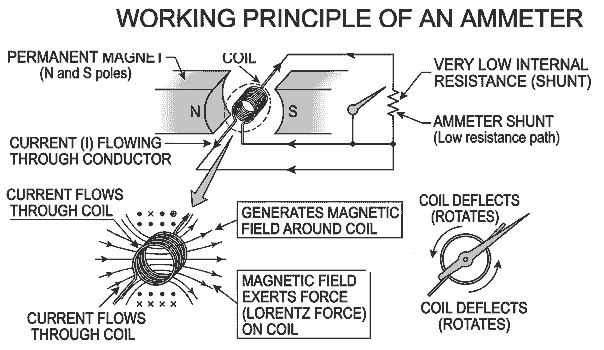
An ammeter contains a coil. As current passes through it, it generates a magnetic field, which exerts a force on the coil and causes the pointer attached to it to deflect. This deflection of the needle depends on the magnitude of the current—the greater the current, the greater the rotation. Based on this, the current value is read on the scale.
To ensure accurate measurement, the ammeter’s internal resistance is kept very low, so that it does not affect the flow of current in the circuit. This principle is also associated with Ohm’s Law , which explains the relationship between current, voltage, and resistance.
Some ammeters also use shunt resistance to allow higher currents to be measured safely and to prevent damage to the instrument.
Read More In Hindi: मेगर क्या होता है?
Types of Ammeter and their uses
Ammeters are classified into different types based on their working principle, current type (AC/DC) , and purpose. Each type has its own characteristics, accuracy, and application area, so choosing the right ammeter is crucial.
Analog Ammeter
This is a traditional ammeter, with a needle (pointer) moving across a scale to indicate the current. It easily displays changing current, but human error can occur when reading the value.
Digital Ammeter
This is the most modern and widely used type of ammeter. The current value is displayed directly on an LED or LCD screen, providing clear and accurate readings. It is widely used in laboratories and electronic equipment.
Moving Coil Ammeter
It is used to measure DC (Direct Current) only. A coil rotates in a permanent magnetic field, causing the needle to deflect. It is a very sensitive and highly accurate instrument, so it is used for precision measurements.
Moving Iron Ammeter
It can measure both AC and DC current. In it, soft iron pieces move due to magnetic influence. It is strong, durable, and inexpensive, but its accuracy is lower than that of a moving coil ammeter.
Electrodynamometer Ammeter
It is a high-quality ammeter, in which a moving coil operates in a magnetic field generated by a stationary coil. It can measure both AC and DC current with a high accuracy of approximately 0.1% to 0.25%. Its calibration is the same for both types of current, so it is used for standard measurements.
Hot Wire Ammeter
It is based on the heating effect of current. When current passes through a thin wire, it heats up and expands, and this expansion is measured to determine the current. It is useful for both AC and DC, especially at high frequencies.
Integrating Ammeter
This ammeter calculates the total energy by adding the current over time. It is used to measure consumption over a long period of time. The best example is the watt-hour meter, which measures electricity consumption.
Read More In Hindi: स्टेपर मोटर क्या होता है?
Difference Between Analog & Digital Ammeter
Both analog and digital ammeters are intended to measure current, but their functionality, accuracy, and uses differ significantly. The key differences between the two are clearly explained below:
| Basis | Analog Ammeter | Digital Ammeter |
|---|---|---|
| Method of reading | By means of a needle (pointer) and a scale | In digits on the screen (LED/LCD) |
| Accuracy | Less chance of human error | More precise and clear |
| Taking readings | You have to read the scale carefully. | Displays the numbers directly, easy |
| Response | Smoothly displays changing streams | Very fast and stable readings |
| Design | Simple and traditional | Modern and advanced |
| Use | Old Equipment and Basic Experiments | Modern appliances and electronics |
| Cost | generally cheaper | A little expensive |
Read More In Hindi: ब्रशलैस डीसी मोटर क्या होता है?
Construction of an Ammeter
Ammeters are designed to accurately measure current without disturbing the flow of current in a circuit. Therefore, they are designed to have a very low internal resistance and not disturb the circuit.
Internal Resistance of the Ammeter
The internal resistance of the ammeter is kept very low or almost negligible. This is intended to ensure that there is no additional interference with the current flowing in the circuit and that the measurement is accurate to the actual condition.
Main Components Of Ammeter
An ammeter consists of several important parts that together ensure accurate current measurement:
- Coil (Galvanometer): This is the main part of the ammeter. When current passes through it, it rotates in the magnetic field and the measurement process begins.
- Permanent Magnet: It provides a constant magnetic field around the coil, which exerts force on the coil and causes it to deflect.
- Shunt Resistance: This is a very low-resistance wire connected in parallel with the coil. Its function is to allow more current to pass through it and protect the ammeter, thereby increasing its measurement range.
- Pointer: It is connected to the coil and when it rotates it shows the value of current on the scale.
- Scale: It is calibrated in amperes (A) on which the current reading is read.
- Control Spring: It balances the coil and brings the pointer back to zero when the current is turned off.
- Zero Adjustment Knob: It is used to set the pointer to the correct zero position before starting the measurement.
Read More In Hindi: इलेक्ट्रिकल रिले क्या होता है?
Ammeter Connection: How to Connect an Ammeter
It is very important to connect the ammeter correctly to the circuit, as incorrect connection may not only give incorrect readings but may also damage the instrument.
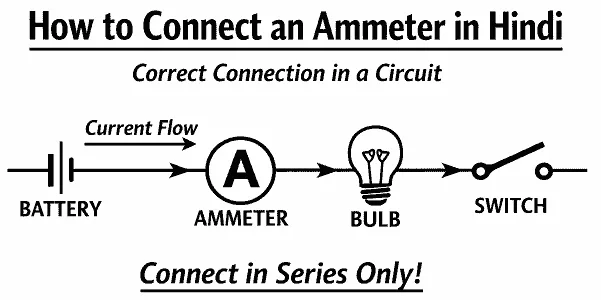
In this connection, the entire current coming out of the battery first passes through the ammeter and then reaches the bulb, due to which the ammeter is able to give accurate measurement.
Step-by-Step Connection of an Ammeter
- First of all, turn off the power supply for safety.
- Cut the wire in which the current is to be measured or open the circuit.
- Connect the positive (+) terminal of the ammeter to the end facing the power source (battery/phase).
- Connect the negative (-) terminal of the ammeter to the load (such as a bulb).
- Now complete the circuit and turn on the power and observe the reading.
Common mistakes in ammeter connection
When using an ammeter, even a small error can result in inaccurate measurements or damage the instrument. Therefore, the following points should be carefully considered:
- Connecting ammeters in parallel: Ammeters should never be connected in parallel. Doing so can cause excessive current to flow, which could damage or burn the ammeter.
- Using without checking the rating: Every ammeter has a specific current range. Using it at a voltage or current higher than its rated capacity can be harmful.
- Neglecting polarity (DC): It is important to connect the ammeter in the correct direction in a DC circuit. Connecting the positive (+) and negative (-) terminals in reverse can result in inaccurate readings or the needle moving in the opposite direction.
Read More In Hindi: सॉफ्ट स्टार्टर क्या होता है?
Attributes of an Ideal Ammeter
An ideal ammeter is one that, while measuring the current in a circuit, does not affect the behavior of the circuit itself. A perfectly ideal ammeter is not possible in real life, but it is important to understand its properties.
- Zero internal resistance (Internal Resistance = 0)
- Negligible voltage drop
- High Accuracy
- High Sensitivity
- Very low energy consumption
- not affected by temperature
- Fast Response
Read More In Hindi: वोल्टेज क्या होता है?
Temperature Effects on Ammeter and Their Prevention
Temperature directly affects the accuracy of an ammeter, as it is a sensitive electrical measuring instrument. When the external or internal temperature changes, the resistance of the coil inside the ammeter also changes.
What happens when the temperature rises?
- the resistance of the coil increases
- The value of current in a circuit is affected by
- The ammeter may show a lower or incorrect reading than the actual value
Additionally, when current passes through the ammeter, it also undergoes internal heating (self-heating), which can introduce additional error in the measurement.
Solution Of this problem
To reduce this error, swamping resistance is used in the ammeter.
- This is a special type of resistance whose temperature coefficient is very low or almost zero.
- It is connected in series with the ammeter coil.
- This keeps the total resistance constant, thereby reducing the effect of temperature.
Usually this resist is made from a material like Manganin, which is very little affected by temperature changes.
Rising temperatures can cause errors in ammeter readings, but this effect can be significantly reduced by using swamping resistance.
Uses of an Ammeter
The main uses of ammeter are as follows:
In Electrical Labs
The most common use of an ammeter is in electrical laboratories. It helps students and researchers accurately measure the current flowing in a circuit, making the results of experiments safe and reliable.
In Household Circuits
Ammeters are used in homes to measure power consumption and ensure circuit safety. They also help detect faults or short-circuits in household appliances.
Industrial Usage
In the industrial sector, ammeters monitor the current of machines, motors, and heavy equipment. This ensures the efficiency and safety of the equipment, keeping the production process smooth and safe.
Read More In Hindi: MCCB क्या होता है?
Frequently Asked Questions (FAQs)
Question 1. Why is the internal resistance of an ammeter low?
The internal resistance of an ammeter is low so that it does not affect the original current in the circuit when connected to it. If the ammeter’s resistance were high, it would cause a voltage drop in the series and reduce the current, resulting in inaccurate measurements. Therefore, it is designed to provide accurate measurements of the circuit’s current even when connected in series.
Question 2. How is the range of an ammeter increased?
To increase the range of an ammeter, it is connected in series with a shunt resistor. A shunt resistor is a small resistance connected in parallel with the ammeter. It bypasses the excess current, allowing the ammeter to measure only a portion of the current. This way, higher currents can be measured without damaging the ammeter, increasing its range.
Question 3. What is the least count of an ammeter?
The least count of an ammeter is the smallest current the ammeter can accurately measure. This indicates the ammeter’s sensitivity, or measuring capacity. For example, if the ammeter’s scale is 0–10 A and the smallest division is 0.1 A, its least count would be 0.1 A.
Question 4. What is the difference between a galvanometer and an ammeter?
The main difference between a galvanometer and an ammeter is their purpose and design:
Galvanometer: Designed to measure very small currents and only indicates the presence and direction of current, not to measure it directly. Its internal resistance is very high.
Ammeter: This is a modified version of a galvanometer, connected in series with a circuit to measure the overall current. Its internal resistance is very low so that it does not affect the current in the circuit.
Question 5. What is the difference between a moving coil vs. a moving iron ammeter?
Difference between Moving Coil and Moving Iron ammeter: Moving Coil ammeter measures only DC current and its scale is more accurate and linear, and its internal resistance is less. Moving Iron ammeter can measure both AC and DC current, but its scale is slightly non-linear and accuracy is less, and its internal resistance is more. Moving Coil works on torque, while Moving Iron works on magnetic attraction/repulsion.
Conclusion
Understanding what is an ammeter and how it works is very important for anyone learning electronics or electrical work. It is not just a measuring device—it helps you know how much current is flowing in your circuit.
If you connect the ammeter correctly, choose the right range, and follow proper polarity, it will give you safe and accurate readings every time.
For students or anyone planning a career in electronics or electrical engineering, learning what is an ammeter builds a strong basic understanding and helps you easily measure and check current in any circuit.